Furniture Design for Northwest Indiana Homes


A homeowner in Dyer stands in an empty living room with a tape measure in one hand and a phone full of furniture photos in the other. The old sofa never quite fit: it crowded the walkway, left guests perched at the edge, and showed wear sooner than expected. Replacing it is a chance to solve those everyday problems, not just choose a different color.
For families in Dyer, Crown Point, St. John, Schererville, Munster, and across Northwest Indiana, good furniture design starts with a practical question: will this piece suit the room, the people using it, and the way the household lives? At Groen's Fine Furniture, a family-owned retailer serving NWI since 1983, that question guides conversations about comfort, materials, and custom options.

Furniture design isn't a style label. It's the work of matching proportion, function, comfort, materials, and appearance to a particular home. A resource such as Jessie's Home can offer additional inspiration, but a saved photo still has to pass the actual-room test: will the furniture fit, leave clear paths, and feel good after a long day?
Start with the room and the household. A piece earns its place by working for the people who use it, not by looking right in a photograph.
Why Furniture Design Matters in a Real Home
That Dyer living room needs more than a sofa that looks attractive. The family needs a route from the entry to the kitchen, seats that work for different ages, and a layout that gives everyone room to settle in. Those needs influence the sofa's width and depth, the placement of chairs, and whether a sectional's shape helps the room or blocks its natural paths.
A useful design decision begins with what happens in the room. Does the family gather for conversation, stretch out to watch a movie, or host relatives for dinner? Are children and grandparents using the same seating? A clear answer helps narrow choices before color, finish, and decorative details take over.
This is why furniture design should happen room by room and life by life. A compact chair might work beautifully beside a window but feel cramped as the main seat in a family room. A substantial dining table may suit a large gathering space, yet overwhelm a smaller room where people need to pass behind chairs. Matching scale to use is the difference between furniture that merely fills space and furniture that supports daily routines.
Durability belongs in that decision, too. A household that uses its sofa every evening needs different construction and upholstery priorities from someone furnishing a rarely used sitting room. Families shouldn't have to accept an awkward fit just because a standard piece is readily available. Custom Furniture can help resolve a specific dimension or layout problem when the room's constraints matter more than a showroom-ready setup.
Our family has helped Northwest Indiana homeowners weigh these trade-offs across generations of ownership. Honest guidance means asking what the room needs before recommending what looks good. The right piece should feel comfortable, leave the household room to move, and keep serving the family after a trend has passed.
The Core Principles That Guide Every Good Piece
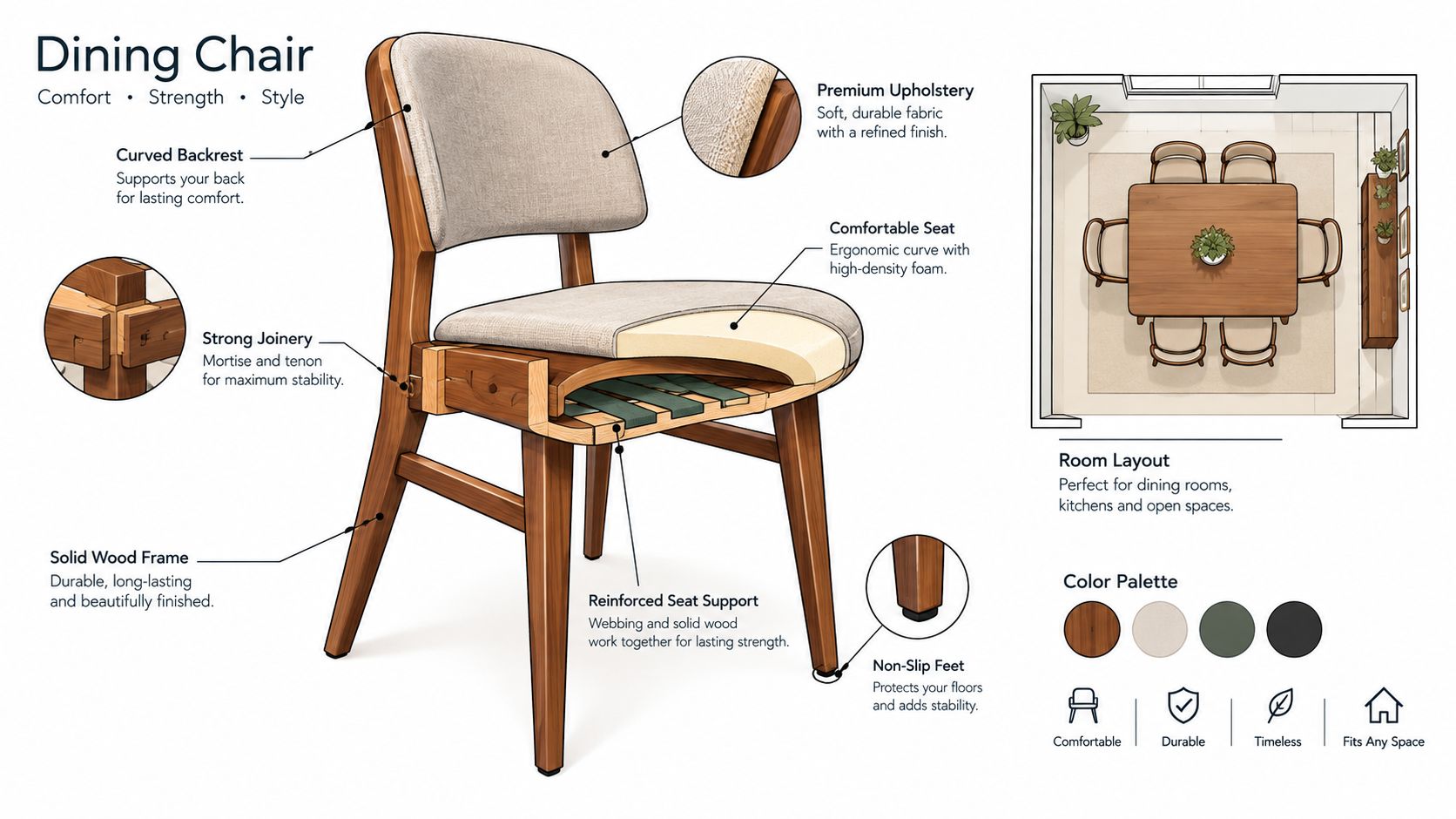
A living room shows how furniture design principles work together. A sectional may look balanced on its own but disrupt the room if its chaise blocks the doorway. A handsome chair can still disappoint if the seat feels too high or too deep for the people who use it. Good design keeps proportion, function, comfort, durability, and visual harmony in the same conversation.
Begin with proportion and function
Proportion means more than matching a piece to the room's overall size. It also means preserving useful negative space so people can walk through, pull out dining chairs, and reach a lamp without squeezing past furniture. Before choosing a large sofa, map its footprint and check that doors, windows, and household pathways remain usable.
Function comes next. Decide whether the room is primarily for conversation, reading, television, entertaining, or a mix. A family that gathers for movie nights may value a different sofa arrangement from a household that hosts face-to-face conversations.
A room diagram can make these choices clearer. Groen's guide to measuring furniture helps shoppers think through room and furniture dimensions before committing to a layout.
Treat comfort as fit
Comfort isn't only about a soft cushion or appealing upholstery. Seat height, seat depth, and back support all influence how someone sits, stands, and relaxes. A study of university students found mismatches between users' body dimensions and existing chair dimensions, and proposed example measurements such as a 33.2 cm seat height, 43.6 cm seat width, and 42.0 cm seat depth (study of chair dimensions and user fit). Those figures aren't a universal recipe for every home; they reinforce the value of assessing fit against the people who'll use the chair.
Try the seat the way it'll be used. Sit back, rest your feet, and check whether the seat supports your posture without pressing uncomfortably behind the knees.
Durability and harmony finish the job. Choose construction suited to daily use, then coordinate shape, finish, and upholstery so the room feels connected rather than assembled from unrelated pieces. Those principles apply to a stock sofa and a made-to-order dining set alike.
Major Furniture Styles and the Households They Fit
A style should help a household make decisions, not dictate them. Traditional furniture often suits rooms where familiar forms and a more formal feel belong. It can bring presence and detail, but its scale and ornament may feel heavy in a small room or in a home where people want a more relaxed look.
Modern design tends toward clean lines and visual lightness. That can help a room feel open, but a clean profile shouldn't be mistaken for comfort. Check the seat depth and back support in person, especially if the chair or sofa will see long stretches of use.
Transitional style often works well when several generations share a home or weigh in on furniture choices. It balances classic shapes with simpler details, making it easier to coordinate with existing pieces. Homeowners exploring how styles can work together may find Ecuadane's guide to luxury design styles useful for building a visual vocabulary before shopping.
Choose for the household, not the label
Farmhouse and rustic styles can create a welcoming, lived-in feeling, but surface texture and finish need to suit the household's maintenance habits. A busy family may prefer materials that are easy to care for over a delicate finish chosen only for its appearance. Mission furniture and Amish-inspired pieces often emphasize sturdy construction and clean lines, a practical combination for shoppers seeking lasting Solid Wood furniture.
The brands available in a showroom can help translate those style preferences into specific choices. Flexsteel is an option to explore for upholstery focused on durability, while Bassett offers a range of looks for shoppers comparing silhouettes and finishes. The useful question isn't which brand or style wins. It's whether the construction, dimensions, and appearance make sense for the room.
A style is a starting point, not a verdict. Test the piece against your traffic paths, care routine, and comfort needs before falling in love with its name.
Homeowners can also use this guide to mixing furniture styles to think through combinations. A room doesn't need a single matching set to feel cohesive. Repeated finishes, complementary shapes, and consistent comfort priorities can connect different pieces across generations of family purchases.
Materials and Construction Choices That Decide Longevity
A piece can look polished in a showroom and still be a poor fit for long-term use if its materials and construction don't suit the home. Buyers should ask what the frame, surface, joinery, and upholstery are made to withstand. The label matters less than how the components are assembled and whether they can be maintained.
Solid wood deserves particular attention because it moves as moisture conditions change. A review describes humidity cycling between 35% and 85% relative humidity at 20 °C as a recognized test range for dimensional response, while another reported interior benchmark puts equilibrium moisture content near 10–12% (review of wood dimensional stability). Those are technical references, not a promise that every home stays at the same conditions. The practical point is that wood changes size, so construction has to allow for movement across the grain.
Inspect the construction, not just the finish
For a solid-wood table, ask about kiln-drying targets, acclimation, panel construction, and the joinery that holds the top to its base. Wide panels need room to expand and contract. Movement-accommodating details can include elongated fastener holes, floating panels, and breadboard-end allowances. Rigidly fixing every part across the grain can invite stress, cracking, or warping as conditions shift.
A guide to mortise-and-tenon joinery can help shoppers recognize one traditional way of connecting furniture components. Drawer construction, frame stability, and access to repair matter as much as a smooth finish. Ask how a piece can be maintained if a joint loosens or a surface needs attention.
Upholstery needs the same scrutiny. Performance fabrics can be useful for active households, but shoppers should compare cleaning instructions and feel, not rely on the label alone. Leather and fabric each have care trade-offs. Cushion construction also affects the way a sofa feels over time, so sit long enough to notice whether the seat supports the body or collapses into a shape that's hard to leave.
A useful showroom checklist is straightforward:
- Wood and panels: Ask how the wood is dried and how wide surfaces are designed to accommodate movement.
- Joinery and drawers: Check that parts feel secure, and ask how joints or drawer components can be serviced.
- Upholstery and cushions: Compare feel, cleaning requirements, and repair options.
- Everyday exposure: Explain how often the furniture will be used and whether children, pets, or direct heat affect material selection.
Applying Furniture Design Room by Room
Room-level furniture design is mostly about matching dimensions and placement to everyday use. Homeowners get better results when they measure first, identify the room's main job, and consider how people move through it. Color matters, but it can't fix a blocked doorway or a table that leaves too little room to sit.
Living and entertainment rooms
For a living room, begin with the main route through the space. Check a sectional's full depth and chaise placement, then plan where recliners open so they don't obstruct a walkway. A smaller sectional with a deeper seat may serve a household better than a larger standard layout if comfort is the priority and the room's paths stay clear.
In an entertainment space, arrange seating around comfortable sightlines rather than pushing every piece against a wall by default. Leave access to doors and storage, and test the seating position from the places family members will use. A room should work for conversation as well as screen time.
Bedrooms and home offices
In a bedroom, match bed height to how people get in and out, and consider storage needs before choosing a bulky frame. Mattress support matters to rest and health, so a shopper comparing Serta and Beautyrest mattresses should use the Helpful Mattress Guide and try options in person. Don't reduce sleep wellness to a specification sheet; the goal is a mattress that supports comfortable, restorative rest.
A home office needs a desk and chair that support the way someone works. Check desk height, legroom, chair fit, lighting, and storage access. If files or equipment need a permanent home, plan for that storage before choosing a desk with a footprint that leaves the room cramped.
Dining rooms and custom fit
Dining rooms depend on the relationship between table size, chair width, and clearance around the table. Measure the usable floor area and consider how far chairs need to move when people sit down. A table that fits only when nobody is seated doesn't fit the household's real routine.
Custom dimensions can be useful when a room has an unusual shape or the family needs a specific seating arrangement. A showroom conversation can help determine whether a different table shape, a revised size, or a more compact chair solves the problem. Each choice should follow the room's actual use, not a display's convenient arrangement.
Trends, Sustainability, and Why Heirloom Quality Keeps Winning
Trends change more quickly than a well-made dining table should. The Bauhaus offers a useful example of design that outlasted its institution: architect Walter Gropius founded the school in Weimar, Germany, in 1919, and it operated until 1933, when it closed under pressure from the Nazi regime. The school moved to Dessau in 1925 and then Berlin in 1932. Although it lasted only fourteen years, its emphasis on functional forms and industrial production continues to influence furniture design (Metropolitan Museum of Art history of the Bauhaus).
Marcel Breuer led the Bauhaus cabinetmaking workshop from 1924 to 1928, where designers explored furniture that could be functional, lightweight, and suited to industrial production. Breuer's tubular-steel experiments helped shift furniture away from heavy, traditionally upholstered forms. That legacy is a reminder that enduring design isn't just about a look. It connects appearance to function, materials, and how a piece can be made.
Sustainability calls for the same practical thinking. One market report estimates that the share of global furniture production using FSC- or PEFC-certified wood rose from 23.1% in 2020 to a projected 48.7% in 2026, and that take-back programs rose from 4.2% in 2019 to 18.4% in 2026; these are estimates and projections, not a census of every maker. The direction points toward more attention to sourcing and end-of-life options, but a label alone doesn't tell a buyer whether a chair can be repaired or a table refinished.
Judge the whole lifespan
Ask whether upholstery panels can be replaced, cushions and mechanisms can be serviced, and wood surfaces can be refinished. Also ask whether the piece can adapt if the household moves or its needs change. A comparative study of furniture repair found that financial considerations were the primary motivation for repair, while environmental concerns played a minimal role, and that product design affects repairability and willingness to repair. In plain terms, a furniture piece is easier to keep when it's built to be maintained and when repair makes sense for the owner.
Amish Furniture can be a strong choice for households seeking solid-wood craftsmanship and pieces designed to last in a long-term home. Flexsteel and Bassett provide other options to compare for upholstered furniture and style. Buyers should look at construction, serviceability, and fit together, rather than assuming that a sustainability claim or a familiar name guarantees lasting value.
For a closer look at material choices, explore sustainable wood furniture. The most useful measure of sustainability is often whether a family can keep, repair, and use a piece well over time.
Custom Orders and the Decision to Stop Settling
Many shoppers want furniture made to suit their homes, yet choosing a custom order can feel harder than buying what's on the floor. A 2024 survey of 1,016 U.S. adults found that 40% of prospective upholstered-furniture buyers considered customization extremely or very important. Yet only 29% of sectional purchasers, 25% of sofa or loveseat purchasers, and 23% of chair purchasers selected custom orders. That gap suggests decision friction, not a lack of interest.
Custom doesn't mean adding options for the sake of it. It means making the changes that solve a real problem: adjusting a table's shape to fit the room, choosing upholstery that suits the household's care routine, or selecting a seat dimension that feels right. The order of decisions matters. Measure first, settle practical needs next, and choose the look after the essentials are clear.
What a custom order can change versus a stock piece
| Dimension or Detail | Stock Piece | Custom Order (Canadel or Amish) |
|---|---|---|
| Room fit | Uses preset dimensions that may leave awkward gaps or tight pathways. | Can offer sizing and shapes that suit the room more closely. |
| Dining-table design | Comes in a fixed combination of top, base, and finish. | Can coordinate table shape, size, color, finish, and base style. |
| Chair and upholstery choices | Limits the buyer to displayed or preset combinations. | Can allow different chair designs and upholstery selections. |
| Solid-wood details | Follows the maker's standard specifications. | Can be ordered to selected specifications, depending on the piece. |
| Decision effort | Fewer choices can make selection quicker. | More choices call for clear priorities and thoughtful guidance. |
Canadel's UDesign program offers made-to-order dining choices that can include table color, shape, size, finish, base style, chair design, and upholstery. Its catalog advertises approximately nine million possible configurations (Canadel product catalog). That breadth is useful when shoppers know what the room needs. It can also feel overwhelming without a short list of priorities.
Groen's Fine Furniture offers Canadel dining and Amish solid-wood options for shoppers considering made-to-order furniture. Before ordering, ask about dimensions, finish, expected lead time, care requirements, and what can be repaired or refinished later. Custom furniture design guidance can help shoppers start that conversation with clearer questions.
Your Next Step From Inspiration to Installation
Furniture design works best when the room, the body, and the household's routines all agree. Homeowners from Dyer, Crown Point, St. John, Schererville, and Munster can visit a showroom to test recliners, compare sectional depth, and feel performance fabrics before deciding. Ask about custom and Amish options, White-Glove Delivery, and Special Financing, subject to credit approval. Groen's multigenerational team is here to help turn measurements and questions into a comfortable plan.
Visit Groen's Fine Furniture in Dyer or Crown Point to explore Canadel dining, Amish solid-wood furniture, trusted upholstery, and mattresses with helpful guidance. Bring your room measurements, test-drive the comfort, and ask our family about Special Financing, subject to credit approval, and White-Glove Delivery as you plan a home you love.