Amish Furniture Quality: What to Look For


A dining table can look perfect on a showroom floor and still leave a homeowner wondering what's underneath the finish. Families in Dyer, Crown Point, and throughout Northwest Indiana often face that choice: select a readily available table built for a shorter replacement cycle, or invest in Amish furniture and make sure the craftsmanship justifies the commitment.
The answer isn't found in weight or a rustic appearance alone. Amish furniture quality comes from a combination of solid hardwood, careful moisture preparation, traditional joinery, repairability, and honest verification. This practical guide helps NWI homeowners inspect those details in person or online, so a piece can fit the home, the budget, and the years ahead.
Why Amish Furniture Earns Its Reputation
A homeowner comparing two dining tables may notice similar shapes, finishes, and dimensions. One table might be assembled from engineered panels with a decorative surface, while the other uses solid American hardwood and joints designed to handle daily movement. From across the room, the difference can be easy to miss. At the drawer, underside, and frame, it becomes much clearer.
Authentic Amish furniture is commonly recognized by solid hardwood construction and traditional joinery. Independent buyer guidance describes genuine pieces as using solid American hardwoods rather than particle board or MDF, with dovetail and mortise-and-tenon joints serving as important structural indicators. Those details matter because solid wood can be repaired, sanded, and refinished multiple times, helping a piece remain useful for decades. This guide to what Amish furniture is offers helpful background before a shopper begins comparing specific pieces.
The reputation also comes from how the furniture is expected to live. A dining table is not merely a surface for meals. It becomes the place where homework happens, guests gather, and family traditions take root. A bedroom dresser gets opened every morning, and a solid wood bed may move through several rooms or homes. Heirloom value is practical value when the furniture continues serving its purpose instead of being replaced whenever a joint loosens or a finish wears thin.
What buyers are really paying for
A higher investment should reflect visible and hidden work, not a label alone. The buyer is looking for:
- Material integrity: Solid North American hardwood throughout the primary structure, without an engineered core disguised by a wood surface.
- Structural planning: Joints that manage weight, movement, and repeated use instead of depending mainly on staples or thin fasteners.
- Repairability: A finish and construction approach that allows future sanding, touch-ups, and professional refinishing.
- Personal fit: Dimensions, wood choices, and finishes that suit the room rather than forcing the room to accommodate a fixed design.
Recent design coverage describes growing interest in furniture that feels more human, shows evidence of craft, and prioritizes durability and heirloom quality, although direct lifespan comparisons remain limited. That 2026 furniture trends coverage supports the broader observation that buyers increasingly care about how furniture is made, not just how quickly it can be delivered.
The Foundation of Solid Hardwood Construction
Solid hardwood is the first quality signal to inspect. A solid board has grain running through its thickness, so the material remains wood from the visible face to the structural core. A composite panel may have a wood appearance on top while relying on particle board, MDF, or another engineered material underneath.
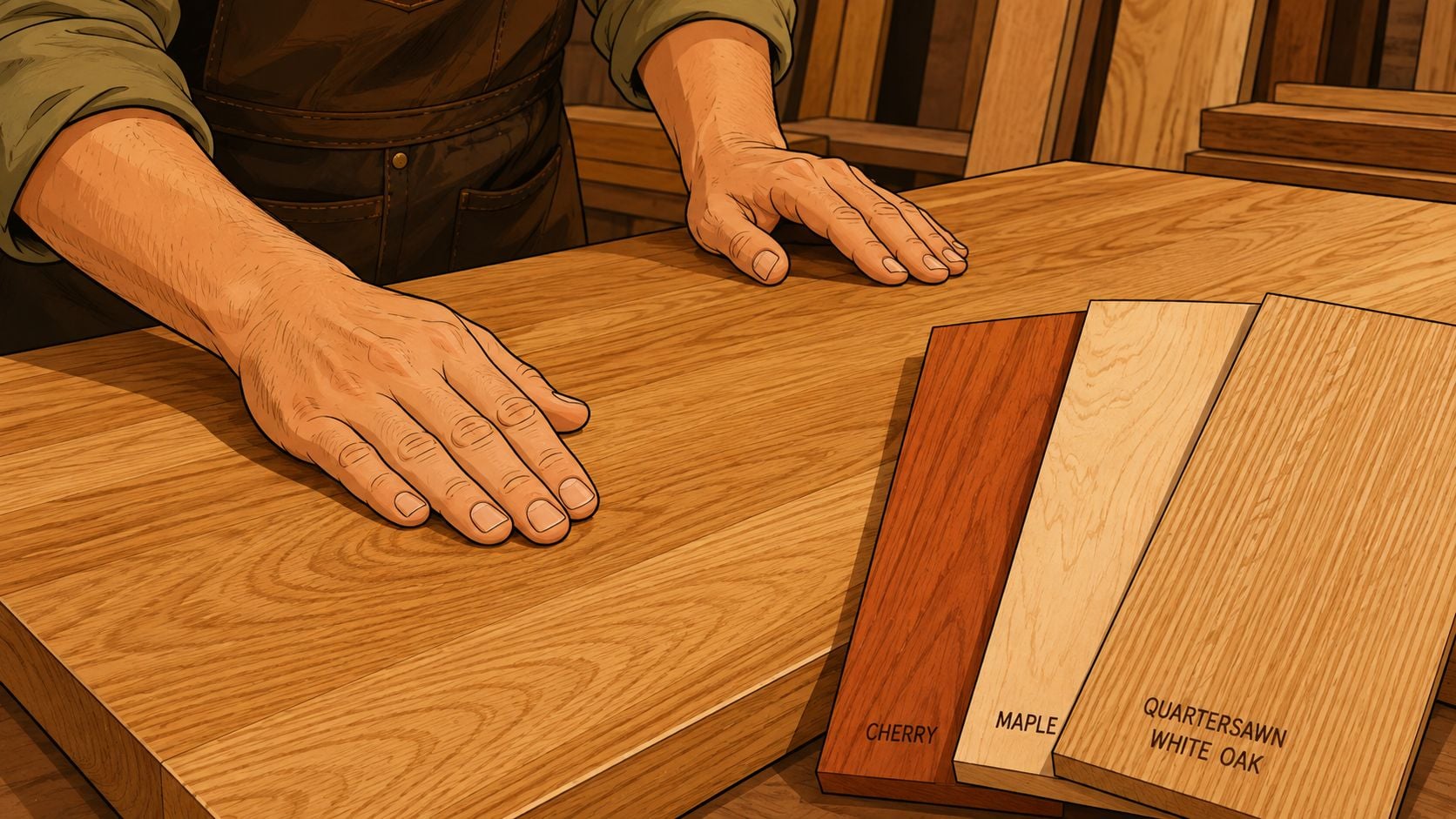
The distinction is similar to the difference between a solid hardwood floorboard and a printed surface over a manufactured core. Both can look convincing at first, but solid wood gives a craftsperson more material to work with over time. Scratches can often be addressed, surfaces can be sanded, and a tired finish can be renewed instead of discarded with the entire piece. A useful primer on the importance of quality hardwood can help shoppers understand why the material choice affects a project's long-term character.
Read the wood, not just the stain
Oak, cherry, maple, and quartersawn white oak each bring a different appearance and working quality. Oak often shows a pronounced grain, cherry offers a warm look that can develop a richer patina, and maple tends to present a smoother, more restrained surface. Quartersawn white oak is valued for its distinctive grain and dimensional stability.
The species matters, but it shouldn't distract from construction. A beautiful stain can make a weak core look impressive, just as a plain finish can allow well-prepared hardwood to show its natural variation. Buyers should inspect the grain at edges, corners, and exposed undersides. If the grain abruptly stops at an edge or the surface appears to wrap over a different material, the piece may use veneer over a composite core rather than solid wood.
Why repairability changes the value equation
Solid hardwood isn't indestructible. It can still be marked by moving boxes, standing water, heat, or careless cleaning. Its advantage is that damage doesn't automatically end the furniture's useful life. A solid surface offers room for repair and refinishing that a thin decorative layer may not provide.
This wood furniture guide can help a shopper connect wood species with room style and everyday use. A busy family dining room may call for a durable surface and a finish that suits frequent cleaning, while a formal bedroom may place more emphasis on grain, color, and aging character.
Practical rule: Ask what the piece is made from before asking which stain is on it. Finish affects appearance, but the underlying material determines what future repairs can accomplish.
Joinery and Moisture Control That Prevent Failure
A well-built piece has to manage two kinds of stress. People load drawers, lean against chairs, and move tables, while the wood itself responds to seasonal humidity. Amish furniture quality depends on construction methods that address both rather than treating appearance as the main objective.
Mortise-and-tenon joinery connects one structural member with a projecting tenon fitted into a matching mortise. Because the joint creates a broad contact area, it distributes load through the frame and helps resist racking and loosening. That matters on chair frames, table bases, and other pieces that receive repeated lateral movement. A deeper explanation of mortise-and-tenon joints gives shoppers a useful vocabulary for questions in a showroom.
Dovetail construction serves a different purpose. Interlocking pins and tails connect drawer sides to the front and back, helping the drawer resist being pulled apart during ordinary use. A drawer built with dovetails can maintain alignment without relying on staples or thin panel stock as its primary structural solution.
Moisture begins before assembly
Wood that hasn't been properly dried continues changing dimension after fabrication. Quality builders typically kiln-dry hardwood to approximately 6% to 8% moisture content before making the furniture, a range described in construction guidance for Amish pieces. The construction methods reference explains why green or under-dried wood can later create cracking, warping, or stress at the joints.
The reason is straightforward. Wood exchanges moisture with the surrounding air, and that exchange can cause it to move. A builder who prepares the lumber for an indoor environment gives the finished piece a better chance of tolerating seasonal changes. The joint design then works with that movement instead of depending only on screws, staples, or adhesive to hold everything rigid.
What to ask about structural work
A shopper doesn't need to become a cabinetmaker to evaluate the basics. Clear questions often reveal whether a seller understands the construction or is repeating a marketing phrase.
- Ask about the wood core: Is the main component solid hardwood, or is a veneer placed over MDF or particle board?
- Ask about the joints: Are drawer boxes dovetailed? Are frame connections mortise-and-tenon or another mechanical joint?
- Ask about lumber preparation: Was the hardwood kiln-dried and prepared for indoor conditions?
- Ask about future care: Can the finish be repaired or renewed if the surface receives normal household wear?
One detail by itself doesn't prove quality. A heavy table can still hide a composite core, and a decorative dovetail may not indicate a fully well-built drawer. The strongest signal is the combination of appropriate hardwood, sound joinery, moisture control, and a seller willing to explain what's beneath the finish.
How to Inspect Amish Furniture Quality In Person or Online
A careful inspection should follow the same order whether a shopper is standing in a Dyer or Crown Point showroom or reviewing an online listing. Start with the material, move to the structure, then verify the maker's description. That sequence prevents an attractive photograph or a reassuring product name from doing all the persuading.
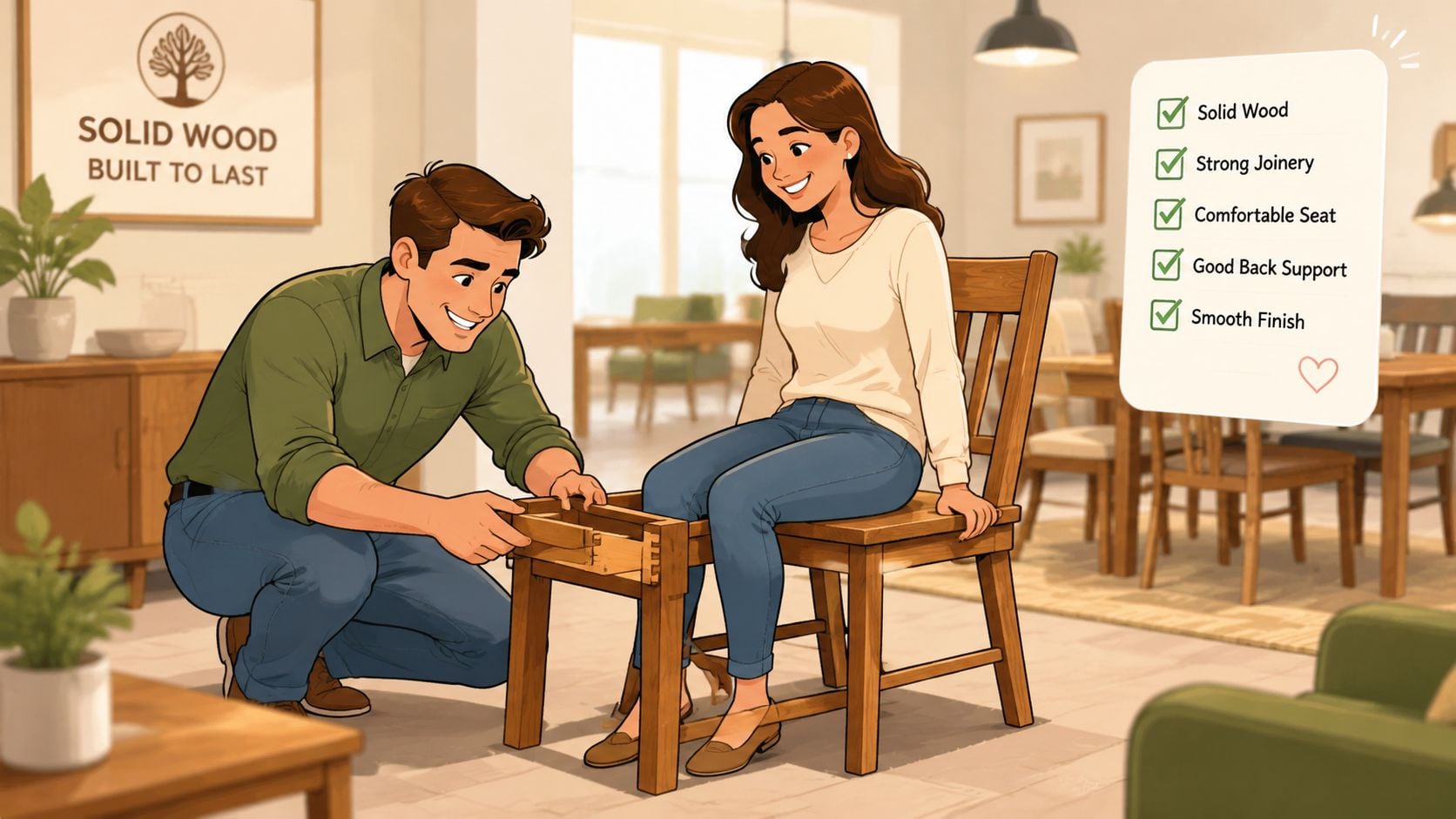
A practical showroom checklist
Begin with the visible surfaces. Look for grain continuity across broad panels and along exposed edges. Solid wood often displays natural variation, while a veneer may show a repeated or abruptly terminated pattern. Variation isn't a defect by itself. It's more useful to ask whether the grain behaves like a thick wooden component rather than a surface image.
Open every drawer that the display allows. Examine the drawer sides, bottom, and corners. Dovetail joints should be visible at the corners, and the box should feel square and stable as it moves. A drawer that wobbles, catches, or depends on staples deserves more questions.
Inspect hidden surfaces. Look beneath a tabletop, inside a cabinet, behind a drawer, and along the back panel. These areas often reveal whether the construction is consistent or whether the most attractive materials were reserved only for what shoppers see first.
Test stability with normal pressure. A table shouldn't rock on a level floor, and a chair frame shouldn't twist easily when a shopper applies ordinary hand pressure. Weight can be a helpful clue, but it isn't proof. A dense composite can be heavy, so stability and joinery matter more than heft alone.
Online verification requires better questions
Online photographs can hide edges, undersides, and drawer interiors. This guide to using online furniture photos encourages shoppers to treat images as evidence to examine, not as a substitute for construction details.
Before ordering, a buyer should request:
- Close photographs of edges and drawer corners, not only full-room images.
- A view of the underside or back, where engineered cores and panel construction may be easier to identify.
- The exact wood description, including whether the primary components are solid hardwood.
- A clear explanation of the maker and construction methods, rather than relying on broad terms such as artisan or handcrafted.
- Care and refinishing information, especially for dining surfaces and frequently used storage pieces.
Authenticity isn't established by a heavier feel or an appealing story. It's established by materials, construction details, and answers that remain consistent when the hidden parts are examined.
A seller who can't explain the wood, joints, or finish may still offer an attractive piece, but the buyer has less evidence that the price reflects genuine Amish craftsmanship. The same inspection principles also apply to American-Made furniture from other construction traditions, since an American origin alone doesn't guarantee solid hardwood or traditional joinery.
Lifespan and Cost Per Year Compared to Mass-Produced Furniture
A dining table can look fine in a showroom and still become a replacement problem within a few years. The better question is how long the piece can serve your household, and whether its construction allows repair when wear appears. One independent comparison places mass-produced furniture's typical service life at 3 to 7 years, while quality Amish pieces commonly last 30 to 50+ years. That Amish craftsmanship comparison also describes solid hardwood furniture as an heirloom category, because it can stay in daily use and pass through generations.
Proper care can extend the useful life considerably. Many Amish pieces are described as reaching 50 to 100 years or more, while solid hardwood furniture is also commonly described as lasting 30+ years and accepting multiple refinishes. The solid wood construction reference provides that longer-life context. Those figures describe possibilities, not guarantees. Daily use, humidity, sunlight, construction quality, maintenance, and future refinishing all affect the result.
| Factor | Mass-Produced Furniture | Amish Solid Wood Furniture |
|---|---|---|
| Typical service life | Often follows a shorter replacement cycle | 30 to 50+ years for quality pieces, with some reaching 50 to 100 years or more when properly maintained |
| Primary material signal | May use particle board, MDF, or composite construction | Commonly uses solid American hardwood |
| Repair path | Limited when a thin surface, fastener, or engineered core fails | Can often be repaired, sanded, and refinished |
| Replacement pattern | More likely to be replaced after surface or hardware failure | Can remain in service and become an heirloom |
| Long-term value | The purchase price covers a shorter ownership period | A higher initial investment can be spread across decades of use |
The comparison suggests a lifespan difference of roughly 4x to 10x or more, depending on use and care. Treat that range as a way to evaluate ownership cost, not as a promise. A piece with a higher price may cost less per useful year if its finish can be renewed and its structure remains sound.
In a Northwest Indiana showroom, inspect the areas that receive daily stress. Open drawers, check how they meet the case, look beneath a tabletop, and ask whether the finish can be refreshed later. Online, request clear views of corners, backs, undersides, and hardware before placing an order. These checks connect the expected lifespan to visible construction evidence.
For families furnishing a dining room, bedroom, or home office, longevity also preserves household history. A refinished table can carry marks from one stage of family life into the next. Quality furniture earns that role through dependable daily use, repairable materials, and construction that supports years of service, not through a label alone.
Customization and Financing That Fit Your Life
A well-made piece still has to fit the room. A table that is too large for the dining area creates daily frustration, while a dresser with poor proportions can make a bedroom feel crowded. Made-to-order furniture lets the homeowner design it the right way, instead of settling for a piece that is merely close.
Custom Amish solid wood furniture may offer choices in wood species, dimensions, finish, hardware, and configuration, depending on the maker and collection. Those details let a family commission furniture for a particular home rather than adapt the room around a fixed catalog item. A warmer cherry appearance can suit a traditional room, a cleaner maple look can fit a contemporary setting, and stronger oak character can support a farmhouse interior.
Before ordering, measure doorways, stairways, and the intended floor area. In a showroom, compare finish samples in the room's lighting and sit in dining chairs long enough to assess comfort. Online, request a written specification for dimensions, wood, finish, hardware, and configuration. These steps help verify that a custom piece is made to the selected requirements, not marketed as artisan-made.
Design it your way
Custom dining does not have to mean Amish construction alone. Canadel's UDesign custom dining program allows shoppers to combine sizes, shapes, finishes, and other options for a made-to-order dining set instead of choosing only from a fixed catalog. Families can coordinate the table, chairs, finish, and surrounding space with greater precision.
Groen's Fine Furniture offers custom order services that include Canadel dining and Amish solid wood options, along with collections from established furniture brands. The practical question is whether the materials, construction, dimensions, comfort, finish, and delivery details match the household's needs. A salesperson should be able to explain what can be changed, what cannot, and how each choice affects the final piece.
Fitting the investment into a budget
Special Financing may help qualified buyers spread payments over time, subject to credit approval. Eligibility review is required, so payment flexibility is not automatic. Read the current terms, including any conditions that affect the total obligation, before accepting an offer. This retailer financing information reflects that standard approval requirement.
Financing should support a considered purchase rather than rush one. Compare the construction details, confirm the final configuration, review delivery expectations, and then ask about available financing. That order keeps the focus on honest value, lasting comfort, and furniture that fits the home.
Caring for Your Amish Furniture and Next Steps
Solid hardwood rewards steady care rather than complicated routines. Dust with a soft cloth, wipe spills promptly, and follow the maker's guidance for wood cleaners and finish-safe products. Keep pieces away from intense heat sources and avoid prolonged direct sunlight when possible, since environmental exposure can affect wood and finish over time.
Seasonal movement is normal for solid wood, so furniture shouldn't be treated as though it were synthetic and completely unchanged. Small signs of aging can develop into a pleasing patina, especially on woods such as cherry. If a surface receives deeper damage or the finish becomes tired, professional refinishing may restore the piece and extend its useful life.
The most reliable purchase combines solid hardwood, sound joinery, moisture-aware construction, and verified workmanship. Families in St. John, Schererville, Munster, and surrounding NWI communities can also evaluate comfort, scale, finish samples, and delivery details in person rather than relying only on online photographs. A showroom visit makes the quality easier to feel and the questions easier to answer.
Groen's Fine Furniture offers custom Canadel dining, Amish solid wood furniture, mattresses from Serta and Beautyrest, and guidance for choosing pieces that suit real homes. Visit Groen's Fine Furniture in Dyer or Crown Point to inspect construction, test the comfort, explore White-Glove Delivery and Interior Design support, and ask about Special Financing plans subject to credit approval.