Blog
Round vs Rectangular Dining Table Guide

For homeowners in Dyer, Crown Point, and throughout Northwest Indiana, the dining table often becomes the hardest piece to choose. The room may be square, the kitchen may open into the living area, and the next holiday gathering may require more seats than an ordinary weeknight meal. The decision between a round vs rectangular dining table isn't only about style. It determines how people talk, walk, serve food, work, and live around the room.
A round table usually creates a more intimate, equal-feeling setting. A rectangular table typically uses long rooms more efficiently and handles larger gatherings with less compromise. The right choice depends on the room's geometry, the clearance needed for pulled-out chairs, and the way the household hosts.
| Table shape | Best room fit | Typical strength | Main limitation |
|---|---|---|---|
| Round | Square, compact, or open dining areas | Face-to-face conversation and easy circulation | Needs even clearance around the entire diameter |
| Rectangular | Long, narrow, or open-plan rooms | Predictable seating and flexible hosting | Corners can interrupt traffic flow |
| Extendable rectangular | Homes that host larger gatherings | Adds capacity while preserving everyday practicality | Requires storage or integrated leaf space |
| Custom round | Rooms needing a specific focal point | Tailored diameter, finish, and base | Larger sizes can consume more usable clearance |
The Social Dynamics of Your Dining Space
A family in Crown Point may be planning a holiday meal, while a household in St. John may need a table that works for homework and Tuesday dinner. In both homes, the table will shape the gathering before anyone sits down. A guest at the end of a rectangle has a different relationship to the room than someone seated within a circle, and that difference becomes noticeable during conversation, serving, and family routines.
Rectangular dining tables carry a long association with structure. In feudal great halls, the head of the household could sit at the head of the table and oversee guests. The arrangement made status and family order visible. Round tables later became associated with equality because no seat is formally dominant. The first known mention of King Arthur's Round Table is often traced to 1155, in Wace's Le Roman de Brut, a historical marker that helped reinforce the round table as a symbol of shared standing. The history of dining tables explains how these social meanings continued into modern furniture language.
Choosing the feeling first
A round table makes it easier for everyone to see one another without a designated head. That suits a smaller family meal, a game night, or a conversation where nobody should feel set apart. The circular outline also softens a room filled with cabinetry, square islands, and straight architectural lines.
A rectangle feels more organized. It gives a host clear ends for serving or seating, creates a natural orientation in a long room, and supports a more formal dinner arrangement. That doesn't make it cold. A solid wood rectangular table with comfortable chairs can feel relaxed, especially when the household uses it for daily meals rather than formal occasions.
Practical rule: Choose the social atmosphere deliberately. Round supports closeness, while rectangular supports order, reach, and larger-group structure.
The meal itself matters, too. A family planning shared dishes and a relaxed evening may appreciate the conversational ease of a round top. Hosts preparing a larger dinner should also think about serving space and the practical details that make the gathering comfortable, including a crowd-pleasing wine guide. For broader planning help, Groen's dining room design guide offers another way to think about the room as a complete setting rather than a table in isolation.
Measuring Your Room and Traffic Flow
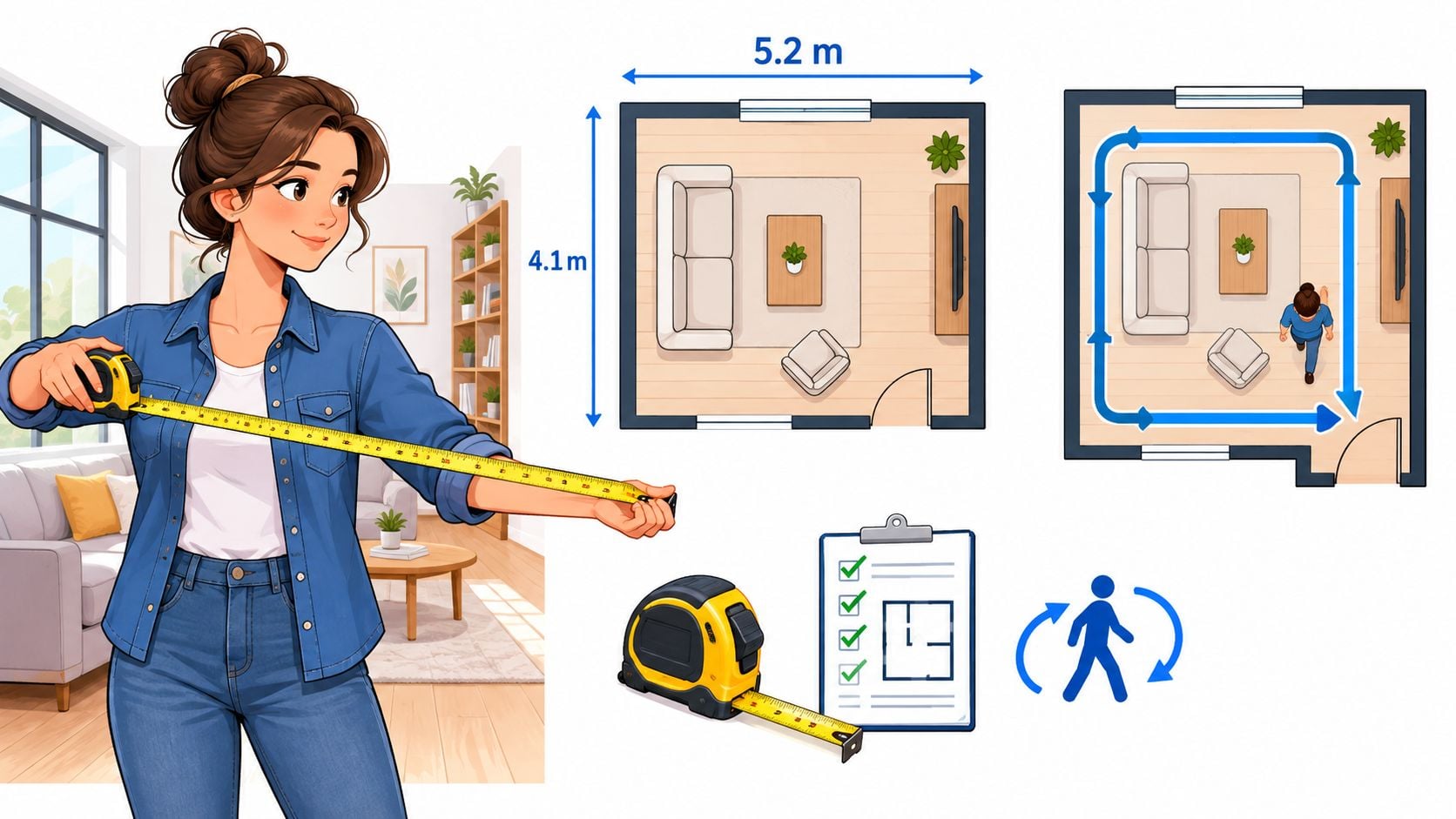
A table can fit the measured dimensions and still make the room difficult to use. The trouble starts when chairs are pulled out, someone walks behind a seated guest, or a cabinet door opens beside the table. Measure the usable room, chair movement, and traffic routes, not only the tabletop.
Start with the space left after baseboards, door swings, built-in cabinets, kitchen islands, and existing furniture are counted. Plan for at least 36 inches between the table edge and nearby walls, cabinets, or furniture. If people must pass behind seated diners, allow 42 to 48 inches. Living Spaces' dining table guide and Houzz's dining table planning advice outline these clearance principles.
The hidden footprint of chairs
Chairs create the spatial cost that shoppers often miss. A round table needs an even clearance ring on every side. One planning guide states that a 36-inch round table may require about a 9.5-foot clearance circle, while another recommends at least 90 cm from the table edge to the nearest wall or furniture. Round and rectangular table sizing guidance demonstrates how chair movement can make a modest tabletop require a generous open area.
A rectangular table offers more control over that footprint. Place its length along a wall or parallel with a kitchen island, using the room's longer dimension. Reserve about 3 feet on each side for pulling out chairs and walking. This clearance-focused table guide explains why a round table that looks compact can still crowd a small room.
A simple floor test
Use painter's tape to mark the tabletop on the floor, then mark the clearance boundary around it. Set out imaginary chairs and trace the routes to the kitchen, living room, hallway, and patio door.
- Check the narrowest path: Someone should be able to pass while another person is seated.
- Mark fixed obstacles: Include sideboards, radiator covers, islands, cabinet handles, and door swings.
- Test everyday movement: Carry a plate through the space and open nearby drawers or doors.
A custom table can solve a tight-room problem when standard dimensions leave awkward gaps. Groen's furniture measuring guide helps households record accurate dimensions before discussing options with a local NWI furniture professional. A clear floor plan keeps a beautiful table from blocking the routes your household uses every day.
Seating Capacity and Hosting Realities
A table's practical capacity depends on usable edge space, not on how many chairs fit beneath it. Plan about 24 inches of table edge per person, with 28 to 30 inches preferred for more formal settings. Elbows, plates, and serving dishes quickly expose the difference between technical capacity and comfortable seating. Arteriors' dining table guide explains why a crowded arrangement can feel uncomfortable even when every chair technically fits.
A 60-inch round table and a 96-inch rectangular table show the central tradeoff. The round top keeps guests close and supports balanced conversation. The longer rectangle provides more individual edge space and accommodates a larger party more naturally. Its extra length can also make chair placement easier, especially when one end must stay clear of a doorway or traffic route.
| Table shape | Dimensions | Comfortable seating |
|---|---|---|
| Round | 48-inch diameter | 4 to 5 |
| Round | 60-inch diameter | About 6 |
| Round | 180 cm diameter | 8 |
| Rectangular | 60-inch length | 6 |
| Rectangular | 96-inch length | 8 to 10 |
| Rectangular | 220 × 100 cm | 8 to 10 |
Published seating examples place a 42-inch round table at 4 seats, a 48-inch round at 4 to 6, and a 60-inch round at 6 to 8. For rectangular tables, a 70-inch length can seat 4 to 8, while an 84- to 108-inch table can reach about 8 to 10, depending on chair size and arrangement. Ballard Designs' table sizing guide offers useful comparisons for planning a realistic setup.
Daily meals versus holiday meals
A smaller round table suits a household that usually eats together without a large spread of serving dishes. Everyone stays close enough for easy conversation, and nobody sits at a distant end. Add platters, centerpieces, homework, or several place settings, though, and the same diameter can feel restrictive.
Rectangular tables provide more predictable expansion. Chairs can be added along the long sides, and many designs accept leaves for larger gatherings. Round tables can expand too, but the room must accommodate the greater diameter or the altered shape. That change can cost more floor space than expected, so measure the expanded arrangement before ordering.
Comfort matters more than maximum capacity. A table that seats fewer people comfortably will serve a household better than one that promises extra chairs but leaves everyone cramped.
Count the people who use the table most often, then add the guests you host regularly. Groen's dining table size guide offers a useful starting point for comparing dimensions, chair clearance, and everyday fit. For a custom table, those measurements give a local NWI furniture professional the information needed to recommend a proportion that supports both daily meals and holiday hosting.
Aesthetic Fit and Customization Options
A dining table should suit the room's proportions, but it should also suit the household's habits. Off-the-rack dimensions can force an awkward compromise. A rectangular table may be too short for the family but too long for the bay window, while a round top may need a diameter that isn't readily available in a standard collection.
That is where custom order furniture earns its value. Canadel dining lets households design combinations of sizes, shapes, and finishes rather than settling for a one-size-fits-all arrangement. A homeowner with a narrow dining room may choose a specific rectangular length, while a family with a square breakfast area may select a round diameter that leaves the right amount of breathing room.
Design it your way
Amish solid wood furniture offers another path for buyers who want heirloom-level craftsmanship and a table made to exact specifications. Solid wood can bring warmth and visual weight to a dining room, while the selected finish determines whether the piece feels traditional, transitional, or clean and contemporary.
Finish should coordinate with the room rather than match every piece mechanically. A table can anchor a space while the chairs add contrast through upholstery, performance fabric, wood tone, or silhouette. Groen's dining room table finish guide gives shoppers a practical way to consider the surface before committing to a custom order.
Details that change the experience
The base matters as much as the top. A pedestal can make it easier to place chairs around a round table, while legs may reinforce a farmhouse, Shaker, or custom look. Rectangular tables can pair naturally with side chairs, armchairs, or a bench, depending on how much flexibility the household wants.
Lighting and tabletop styling should support the shape. A centered fixture reinforces a round table's focal-point quality, while a longer fixture can follow the length of a rectangle. For an evening setting, homeowners may also appreciate guidance on clean burning taper candles, especially when the centerpiece needs to remain proportionate to the table.
Custom furniture is an investment, but it doesn't have to create unnecessary financial pressure. Special Financing is available, subject to credit approval, giving families additional buying power while they select durable materials and made-to-order details. Groen's Fine Furniture in NWI offers custom dining through Canadel and Amish solid wood collections, along with honest guidance rather than a high-pressure decision.
The Case for Round Dining Tables
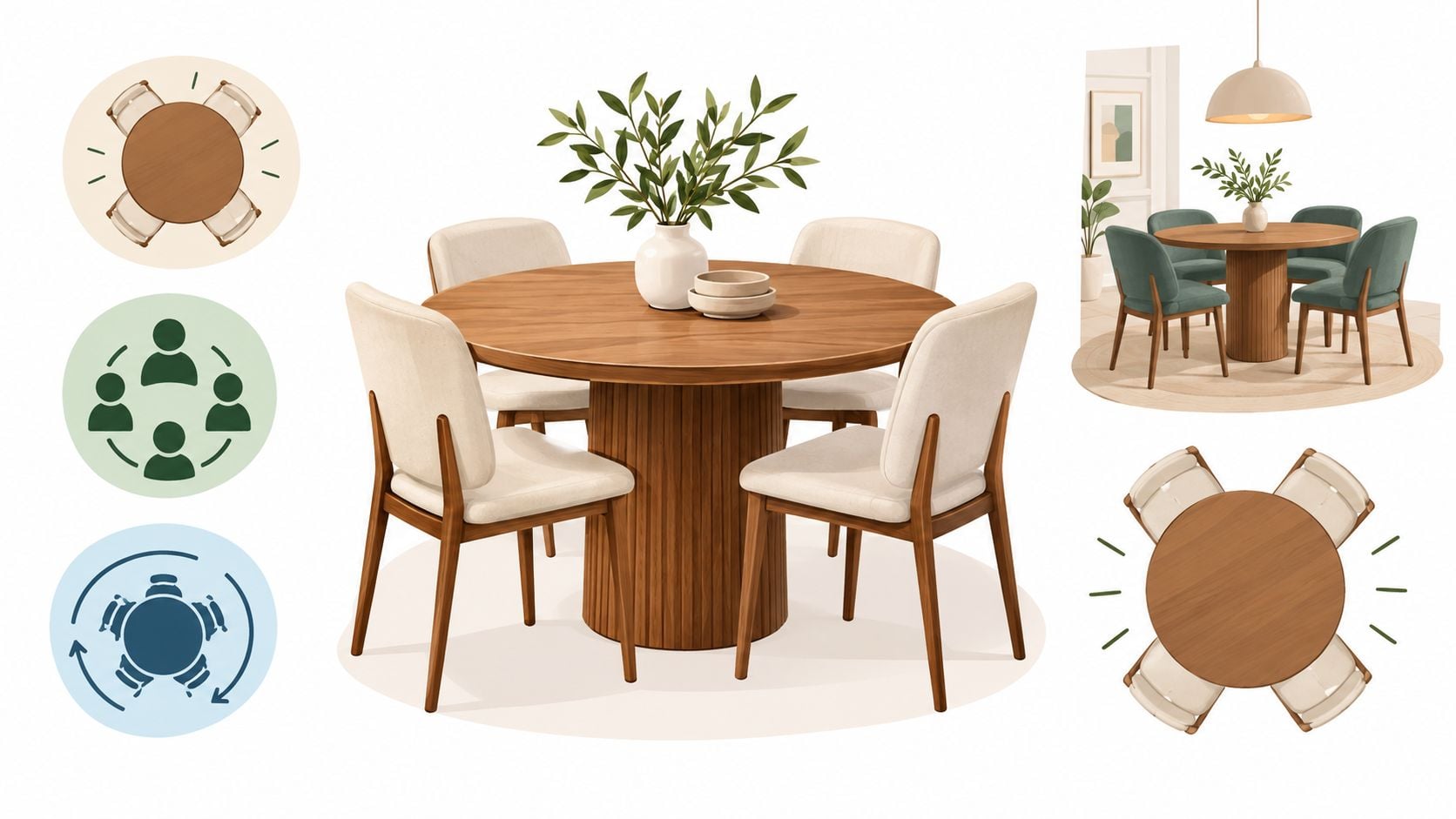
Round tables work best when the room benefits from a central, softer focal point. Their lack of corners helps circulation in compact or square spaces, and the shape can reduce the visual interruption created by straight walls, cabinets, and nearby furniture. BoConcept's dining table guidance similarly places round tables in square rooms and smaller dining areas, while rectangular tables generally suit long rooms.
The social benefit is immediate. Every diner faces the center, and nobody occupies a formally dominant end. That makes a round table especially appealing for family meals, conversation-heavy dinners, and homes where the dining area also serves as a gathering spot between the kitchen and living room.
Where the round shape earns its place
A round table can make a square room feel balanced because it doesn't compete with the room's corners. In an open-plan home, it can also create a distinct dining zone without adding another hard-edged rectangle beside the kitchen island.
The tradeoff appears when the household hosts larger groups. A round top needs even clearance in every direction, and a larger diameter can consume more of the room than expected. Serving food family-style may also become less convenient when platters occupy the center and diners reach across one another.
- Choose round for conversation: It keeps smaller groups visually connected.
- Choose round for square rooms: The geometry uses the room's shape more naturally.
- Choose round with caution for expansion: Larger parties may require a different arrangement or an extendable design.
A round table is the clear recommendation for a compact square dining area with a small everyday group. It isn't the automatic answer for every small room, especially if one side of the room needs to remain a main walkway.
The Case for Rectangular Dining Tables
In a long dining room, narrow eating area, or open kitchen, a rectangular table usually makes better use of the available space. Its straight edges can run parallel to a wall or island, preserving a useful passage on the room's open side instead of demanding equal clearance around the entire top. That hidden chair and traffic space often determines whether the layout feels comfortable.
A rectangular table also supports larger gatherings with fewer changes to the room. Published dining-table sizing guidance commonly places six seats at a 150 × 90 cm table, six to eight at 180 × 90 cm, and eight to ten at 220 × 100 cm. Those figures are starting points, not guarantees. Chair width, leg placement, and the space needed to pull chairs back can change the practical count.
More than a formal dining table
The long shape earns its keep between meals. Children can spread out for homework, an adult can work at one end, and serving dishes can sit along the center while leaving places available around the edges. Rectangular tops also accept benches, side chairs, and armchairs in combinations that can change as the household grows.
Custom sizing is often the better answer when a standard table blocks a walkway or leaves awkward gaps beside a wall. A Northwest Indiana furniture maker can adjust length, width, leg placement, and finish to suit the room, reflecting the practical craftsmanship our family-owned local businesses have built their reputation on.
Extension leaves add another layer of flexibility. The table stays compact for daily meals, then grows for guests, but only if the expanded footprint preserves chair clearance and the main route through the room. Groen's guide to dining tables with leaves stored in the table explains one convenient storage approach.
Corners need attention in busy family spaces, especially near kitchen routes. For long rooms, open kitchens, and households that host more than a small group, a rectangular table remains the stronger practical choice.
Making the Final Choice for Your Home
The right decision becomes clearer when the table is judged against the room and the household together. A round table should earn its place by improving conversation and circulation, not just because it looks softer. A rectangle should earn its place by using the room's length and supporting real hosting needs, not just because it feels conventional.
A useful decision check looks like this:
- Select round when the room is square: The shape fills the center without competing with corners.
- Select rectangular when the room is long: The tabletop follows the room's natural direction.
- Select round for a smaller everyday group: Face-to-face interaction becomes the priority.
- Select rectangular for frequent larger gatherings: Longer edges and extension options support additional guests.
- Choose custom sizing when standard dimensions waste space: Made-to-order furniture can solve a difficult wall, window, island, or walkway.
- Measure the expanded footprint: A table with leaves must still leave comfortable traffic space when fully open.
The honest test
Tape the proposed tabletop on the floor, then measure the clearance from its edge to walls and furniture. Pull chairs out mentally or with temporary markers. If the route from the kitchen to the living room becomes awkward, the table is too large or the shape is wrong, even if the tabletop itself fits.
For families comparing layouts for a wedding, party, or holiday gathering, a practical table shape guide for Surrey events can provide another perspective on how table geometry affects guest interaction. The same principle applies at home: seating plans work best when they account for movement, not just chair counts.
Groen's Fine Furniture has served Northwest Indiana since 1983, with showrooms in Dyer and Crown Point and a multigenerational ownership model centered on personal service. Families from St. John, Schererville, Munster, and surrounding NWI communities can compare round and rectangular options, explore Canadel custom dining, and consider Amish solid wood craftsmanship with guidance from a local team. The store also offers White-Glove Delivery, Interior Design support, and Special Financing subject to credit approval.
A table should feel comfortable before it feels impressive. Sitting in the chair, checking knee room, reaching toward the center, and imagining the route around the table will reveal more than a product photograph. That hands-on test is part of the value of local, five-star service.
Visit Groen's Fine Furniture in Dyer or Crown Point to compare round and rectangular dining tables, explore made-to-order Canadel and Amish solid wood options, and test the comfort of different chairs in person. The family-owned team can help measure the space, discuss White-Glove Delivery and Special Financing subject to credit approval, and create a dining setting that fits the way the household truly lives.