Blog
Custom Dining Room Table: Your Complete Design Guide

For homeowners in Dyer, Crown Point, and throughout Northwest Indiana, the dining table often has to do more than host dinner. It becomes the homework station, the holiday gathering place, the conversation center, and the piece that visually connects the kitchen to the rest of the home. That's why a standard table can look perfect in a showroom yet feel too large, too narrow, or awkward once it reaches the dining room.
A custom dining room table solves that compromise by starting with the room and the household instead of a fixed catalog footprint. Groen's Fine Furniture has helped NWI families sort through those decisions with a personal, five-star approach since 1983. The guidance below focuses on the choices that matter most, from clearance envelopes and seating capacity to solid-wood movement, edge comfort, chair coordination, and the actual custom-order process.
Why a Custom Dining Room Table Is Worth the Effort
Standing in an empty dining room with a tape measure can make a custom order feel like too much responsibility. Deposits, finish samples, production timelines, and a long list of decisions can create the nagging worry that one wrong choice will follow the household for years. Staring at a wobbly table that has survived too many Thanksgivings creates the opposite problem. The need is obvious, but the path forward isn't.
The payoff is practical. A made-to-order table can respond to the room's usable dimensions, the number of people who sit there daily, and the wood tone already present in flooring or cabinetry. Instead of accepting a table that nearly fits, the buyer can specify a more suitable length, width, height, shape, base, edge, and finish.
Customization should solve a problem
Customization isn't decoration for its own sake. A narrower top can preserve a walkway. An oval end can soften a traffic path. A pedestal can eliminate a leg that blocks a chair. A self-storing leaf can keep the everyday footprint calm while still supporting occasional guests.
Programs such as Canadel dining offer made-to-order choices across dimensions, shapes, legs, and finishes. Amish furniture programs emphasize solid-wood construction and handcrafted specifications, with options that can include oak, cherry, maple, and walnut rather than synthetic materials, as described by Amish solid-wood furniture specialists. Buyers can also find custom tables made in shapes including rectangular, round, square, racetrack, and radius-end designs, with selectable bases and finishes, according to custom dining table configuration information.
Practical rule: A table earns its place when it makes daily movement easier, not merely when it fills the most floor space.
Custom furniture also fits a broader shift toward personalization. One 2025 market report valued the global customized furniture market at USD 62.8 billion and projected it to reach USD 128.9 billion by 2034, with tables representing 19.3% of that market, according to customized furniture market data. The same report placed customized dining tables commonly between USD 1,200 and USD 5,600, depending on material and design complexity. Those figures reinforce a simple point. Dining tables are one of the furniture categories where shoppers actively pay for fit, materials, and personal specifications.
A useful design conversation should end with a short, workable specification sheet, not a folder full of inspiration images. Readers comparing the difference between personalized and made-to-order furniture can also review what bespoke furniture means and how it works. For households weighing the value of professional guidance, Resurrect Wood Refinishing's discussion of designer value offers useful context on how design decisions can affect the finished room.
Sizing Your Table to the Room and the Way You Live
The room should determine the table size, not a Pinterest photograph. Start by measuring the usable dining zone, then protect the space required for chairs, serving, and traffic. Standard sizing guidance recommends 36 to 48 inches between the table edge and nearby walls or furniture, with at least 18 to 24 inches reserved for chair movement and 42 inches or more behind active seats where circulation is needed, as outlined in custom dining table sizing guidance.
The comfortable target is the wider end of that range when the table sits beside a kitchen route, doorway, cabinet, or frequently used passage. A table can physically fit and still make every meal feel cramped.
Measure the clearance envelope first
Tape the wall lengths. Mark door swings, windows, radiators, built-ins, cabinet pulls, and the footprint of any chandelier or pendant above the table. Then place temporary tape on the floor to represent the proposed tabletop. Pull imaginary chairs away from the edge and walk the traffic routes while another person sits in the dining position.
For seating, allow roughly 24 inches of table edge per diner, a benchmark supported by dining table measurement guidance. That allocation is workable, but more generous spacing feels better for long meals, serving dishes, and broad armchairs. The room's shape matters just as much as its square footage.
Three practical room examples
A 12 by 12 room often works well with a rectangular table around 60 to 66 inches long and 36 to 40 inches wide, seating about six comfortably when the surrounding circulation is protected. A 10 by 14 room can usually accommodate a longer table around 72 to 84 inches long and 36 to 42 inches wide, with six to eight seats depending on the base and clearance. A 9 by 11 eat-in kitchen is tighter. A round or oval table around 42 to 48 inches across or wide may serve four comfortably, while a narrow rectangular design can work when one side uses a bench and the traffic path remains open.
| Room Size | Recommended Table | Seats Comfortably | Minimum Clearance |
|---|---|---|---|
| 12 by 12 | 60 to 66 inches by 36 to 40 inches | 6 | 36 inches |
| 10 by 14 | 72 to 84 inches by 36 to 42 inches | 6 to 8 | 36 inches |
| 9 by 11 eat-in kitchen | 42 to 48 inches round or oval, or a narrow rectangular table | 4 | 36 inches where possible |
The honest tradeoff is that a table may fit the room perfectly while falling short during holidays. Extension leaves, including butterfly leaves, are the usual answer when the household needs a smaller daily footprint and more seating on occasion. A bench along one side can solve a similar problem with less visual bulk, particularly when the wall side doesn't require chair pullback.
For a room-by-room measurement process, the dining table size guide from Groen's Fine Furniture gives shoppers a useful starting point before visiting a showroom. Measurements should come first. Finish and style decisions become much easier once the table's maximum footprint is known.
Choosing the Right Shape for the Way You Gather
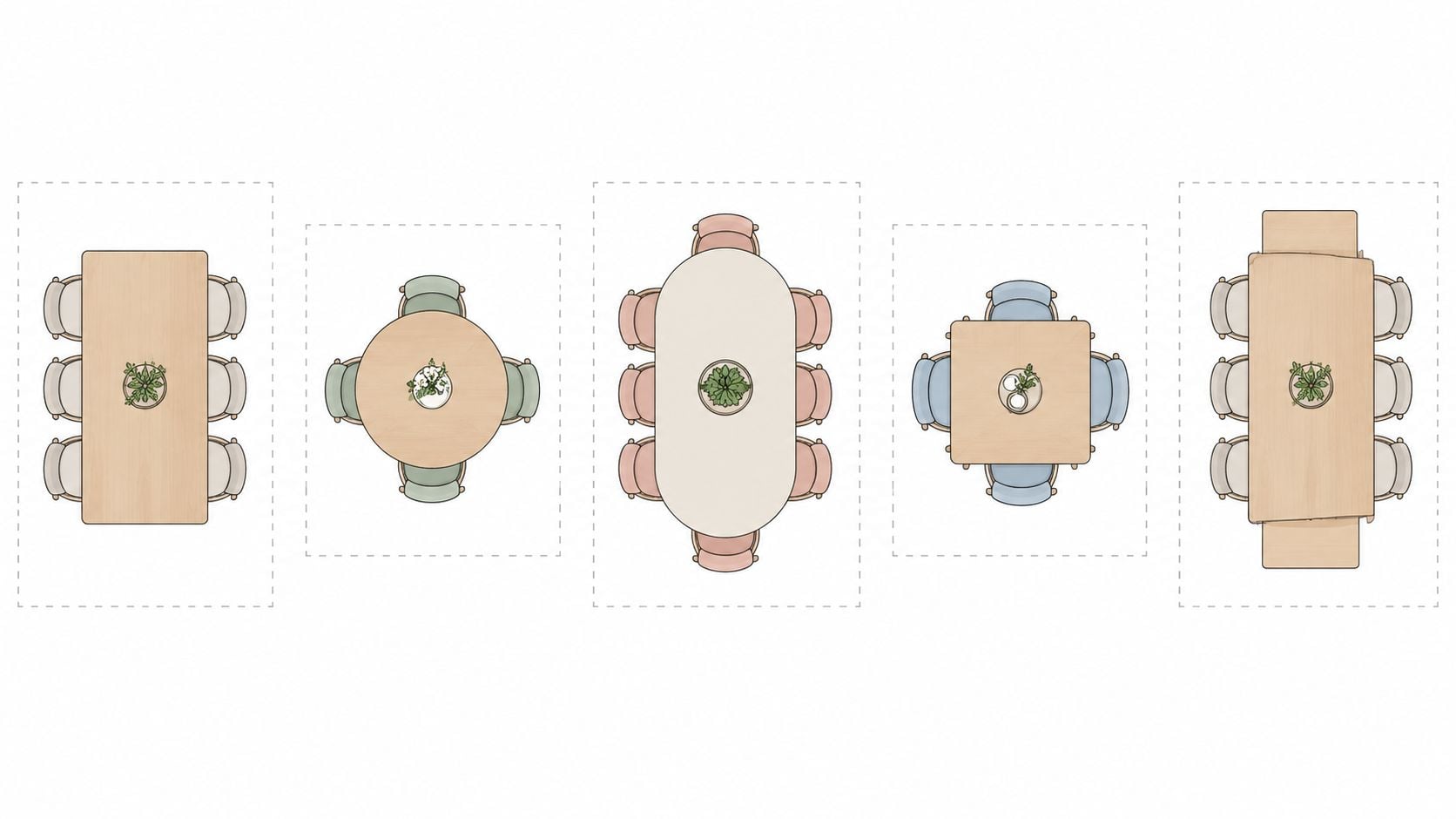
Shape should follow room geometry and gathering habits. A rectangular table is the workhorse because it uses length efficiently, supports conventional seating, and pairs naturally with benches or sideboards. A round table encourages conversation, but it occupies more floor area than many shoppers expect because every chair projects outward from the center.
One global dining table market forecast reported that rectangular tables led revenue with 44.20% in 2025, while oval tables were projected to grow at a 6.72% CAGR through 2031, according to dining table market analysis. Those figures don't determine a household's choice, but they show why rectangular and oval designs remain central to custom programs.
Match the shape to the room
Rectangular: Choose it for a long dining room, open-concept great room, or household that regularly needs six or more places. It offers the clearest seating plan and works well with extension leaves.
Round: Choose it for a square room or a conversation-first household. A pedestal base improves legroom, but a round top rarely extends as neatly as a rectangular one.
Oval: Choose it when a rectangular room needs softer corners without losing directional seating. Oval tables are particularly useful where a sharp corner would intrude into a walkway or where young children move through the room.
Square: Choose it only when the room and seating pattern truly support it. Square tables feel substantial, but four diners is the comfortable default without an extension.
Extendable: Choose it when hosting is occasional rather than daily. The leaf mechanism and storage are real logistics, so nightly diners shouldn't buy an extendable design solely because it offers the largest possible seat count.
Strong defaults for common scenarios
For an open-concept great room, the default recommendation is a rectangular table with a modest extension system. It defines the dining zone and aligns with the room's longer sightlines.
For a formal dining room, an oval or refined rectangular table usually makes more sense than a round design. The choice depends on whether the room needs softer circulation or maximum seating.
For a small eat-in kitchen, a round pedestal is often the cleanest answer. It eliminates corner collisions and keeps chair placement flexible.
For a narrow farmhouse layout, choose a narrower rectangular table, or an oval if circulation is tight at the ends. The goal is not to recreate a staged dining room. It's to preserve an easy route between the kitchen and the rest of the home.
The practical shape and seating tradeoffs are also covered in this guide to maximizing dining space with table shapes. The best custom choice is the one that reduces daily friction, even when it isn't the trendiest silhouette.
Picking Wood, Finish, and Edge Profiles That Last
Wood selection should begin with household reality, not a favorite photograph. Oak and brown maple are dependable choices for active families because their visible grain and forgiving character don't demand a museum-like dining room. Cherry brings warmth and develops deeper color with light exposure, so buyers should expect the table to evolve. Walnut offers dramatic grain and rich contrast, but surface marks can stand out more readily against its darker appearance.
Other strong options include maple for a cleaner, quieter grain, quarter-sawn white oak for pronounced figure and traditional character, and reclaimed wood when variation and history matter more than a uniform surface. Amish programs commonly offer solid woods including oak, cherry, maple, and walnut, with buyers selecting size, wood, stain, and finish, as described by solid-wood Amish furniture guidance.
Compare species by household use
| Wood Species | Grain Look | Durability | Best For |
|---|---|---|---|
| Oak | Pronounced, textured grain | Forgiving for active use | Families wanting visible character |
| Brown maple | Relatively even, adaptable grain | Practical for everyday dining | Transitional rooms and busy households |
| Cherry | Warm grain that deepens with light | Durable with changing color | Traditional rooms and heirloom styling |
| Walnut | Dramatic, dark grain | Durable, but marks can show clearly | Statement tables and refined interiors |
| Maple | Clean, restrained grain | Hardwearing everyday option | Contemporary or quiet interiors |
| Quarter-sawn white oak | Strong figure and vertical grain | Stable, substantial feel | Mission and craftsman settings |
| Reclaimed wood | Varied grain, knots, and patina | Depends on preparation and construction | Rustic rooms and character-driven design |
Finish samples should leave the showroom. A stain that looks balanced under retail lighting can read warmer, cooler, lighter, or darker beside a home's flooring and cabinetry. Groen's team can help buyers compare samples against existing materials, and a thoughtful homeowner should view those samples near the dining room's actual windows and lighting.
Treat the finish as a comfort decision
Conversion varnish and catalyzed lacquer create durable protective surfaces suited to regular dining use. Hand-rubbed oil feels more tactile and can be easier to refresh in certain constructions, but it may require more attentive care. The right finish depends on whether the household prioritizes maximum surface protection, easy repairability, or the natural feel under bare arms during a long meal.
Seasonal movement is the construction issue that separates a stable heirloom from a cracked tabletop. Wood expands and contracts across the grain as humidity changes. Woodworking guidance notes that a 42-inch-wide tabletop may move about 1/2 inch overall, with practical estimates of 1/8 to 3/16 inch per 12 inches of width, depending on climate and species, according to tabletop attachment guidance. Slotted screw holes, figure-eight fasteners, clips, breadboard ends, and floating panels let the top move without transferring stress into the base.
Edge profiles finish the tactile experience. An eased square edge feels clean and contemporary. A bevel adds visual lightness. A roundover is comfortable for frequent contact. A live edge highlights natural irregularity but demands a room that can support its informality. The chamfered Mission edge brings structure without a harsh corner. More guidance on selecting hardwood for longevity and style appears in Groen's wood furniture guide.
For households maintaining an older wood piece, cleaning advice from Sunset Shine Home Cleaning can help clarify why finish care should be approached carefully rather than with aggressive household products.
Matching Leg and Base Styles to Your Table Size
The base controls more than appearance. It determines where knees land, whether chairs can tuck fully beneath the top, and how freely diners can shift around the table. A beautiful base that blocks two seats is an expensive design mistake.
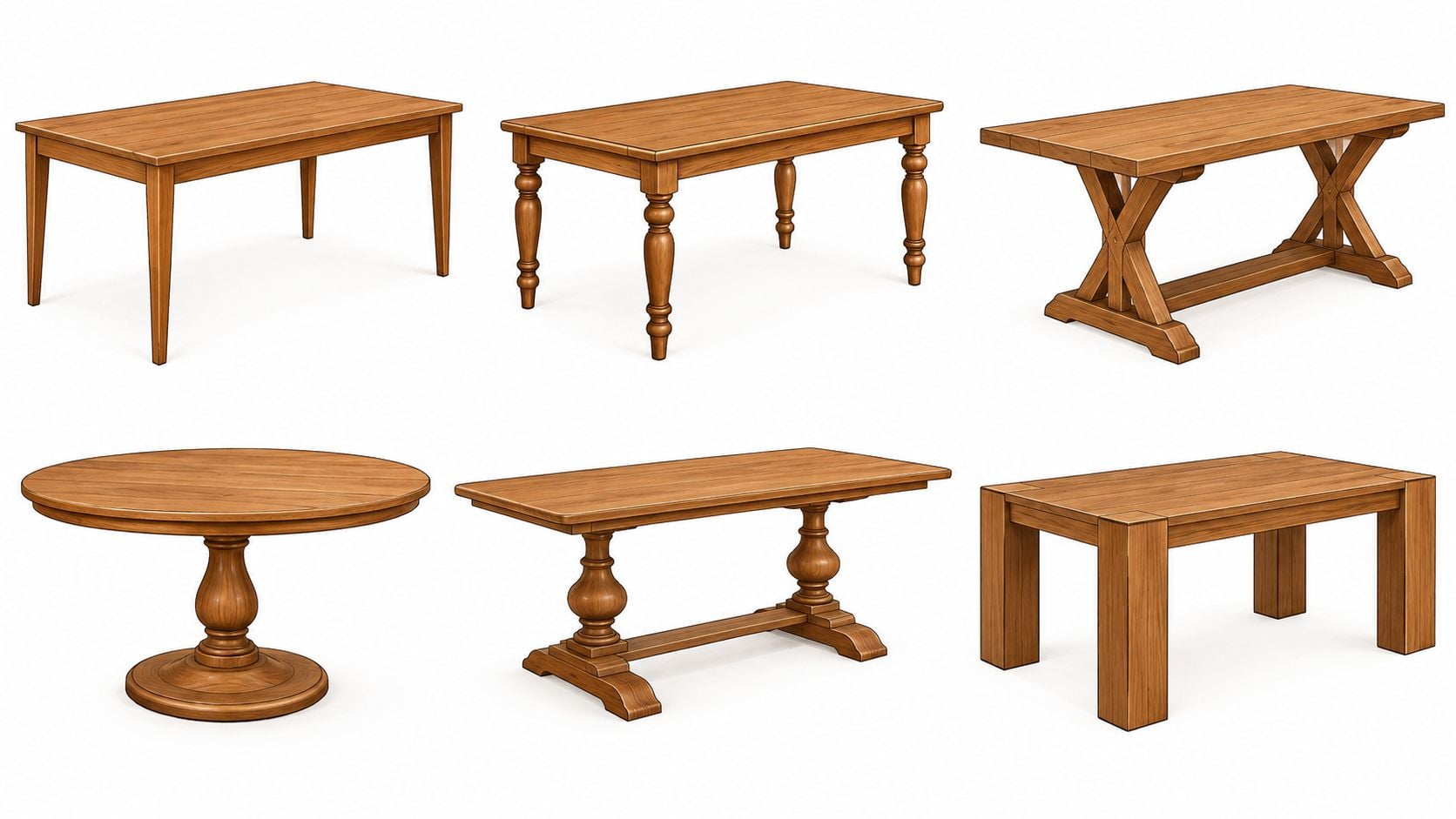
Straight tapered or square Shaker legs are the safest choice for tables under 72 inches because chairs can tuck cleanly and end seating remains practical. They suit traditional, transitional, and contemporary rooms without overwhelming the top.
Compare the main base families
Turned legs add traditional character and work best on a larger tabletop where a small loss of knee room won't reduce the seating plan. They bring visual detail, but their profile can compete with delicate chairs.
Trestle bases belong naturally beneath long farmhouse tables. They create a strong architectural silhouette and keep the table visually grounded, but diners need careful place-setting clearance around the central supports. Armchairs at the ends should be tested before ordering.
Pedestal bases are excellent for round and oval tops under 54 inches because they free diners from corner legs and keep sightlines open. The construction must be heavy and stable enough to resist racking, particularly when people lean against the table.
Double pedestals extend that seating flexibility to longer tables. They make it easier to place chairs along the ends and sides, but they generally add weight and cost.
Chunky modern post legs suit substantial contemporary tops and open rooms. Their strong silhouette can look excellent, but the posts need to stay far enough inward to avoid colliding with knees or chair arms.
Put stability before drama
A busy household needs a stable base, comfortable corners, and clear knee space. Fewer sharp projections matter when children move quickly around the room, but stability matters just as much. The most dramatic trestle or post-leg design isn't automatically the most usable one.
The base should also match the table's visual weight. A thick walnut top can overpower narrow tapered legs, while a lighter maple top may look lost above an oversized pedestal. Canadel custom dining options and Amish solid-wood programs make it possible to coordinate these details instead of accepting a fixed combination.
Coordinating Chairs Without Locking In the Wrong Set
Chairs should be selected after the table's height, apron, edge, and base are understood. A matched dining set can look polished in a showroom vignette while creating knee collisions at home. The first measurement to confirm is the gap between the chair seat and the underside of the apron. A practical target is roughly 10 to 12 inches of clearance, enough to prevent knees from hitting the table frame during every meal.
Seat height matters just as much as appearance. A chair can look proportionally correct and still feel wrong if the seat sits too high or too low relative to the tabletop.
Decide where arms earn their space
Armchairs are excellent at the heads of the table, where guests tend to linger and appreciate additional support. They also consume usable width, so a smaller table may work better with armless side chairs that allow the household to preserve each place setting.
A common arrangement uses two armchairs at the ends and armless chairs along the sides. That combination adds comfort without forcing oversized chair arms into the traffic path. For a narrow room, armless chairs throughout may be the more honest choice.
Choose upholstery for the actual household
Performance weaves and leather are practical for families with children because spills can be addressed more easily than on delicate textiles. Wood seats simplify the visual line and age without tying the room to a particular upholstery pattern, but they provide less padding during long dinners. Upholstered seats offer comfort, yet fabric color and texture should support the table's grain rather than compete with it.
Allow roughly 24 inches of table edge per diner, and remember that a chair needs additional room beyond the table to push back. Groen's guide to choosing dining chairs provides a useful framework for comparing seat height, arm clearance, comfort, and coordination.
Chair test: Sit fully back, place both feet on the floor, and slide the chair beneath the apron. If the knees touch wood or the arms catch the tabletop, the chair isn't ready for the order.
Avoid pairing a heavy traditional table with delicate modern chairs unless the contrast is deliberate and balanced elsewhere in the room. Likewise, bold wood grain needs upholstery that supports its color and scale instead of fighting for attention. Chairs don't have to match the table exactly, but they must share a believable visual language.
Timeline, Pricing, and How Custom Orders Actually Work
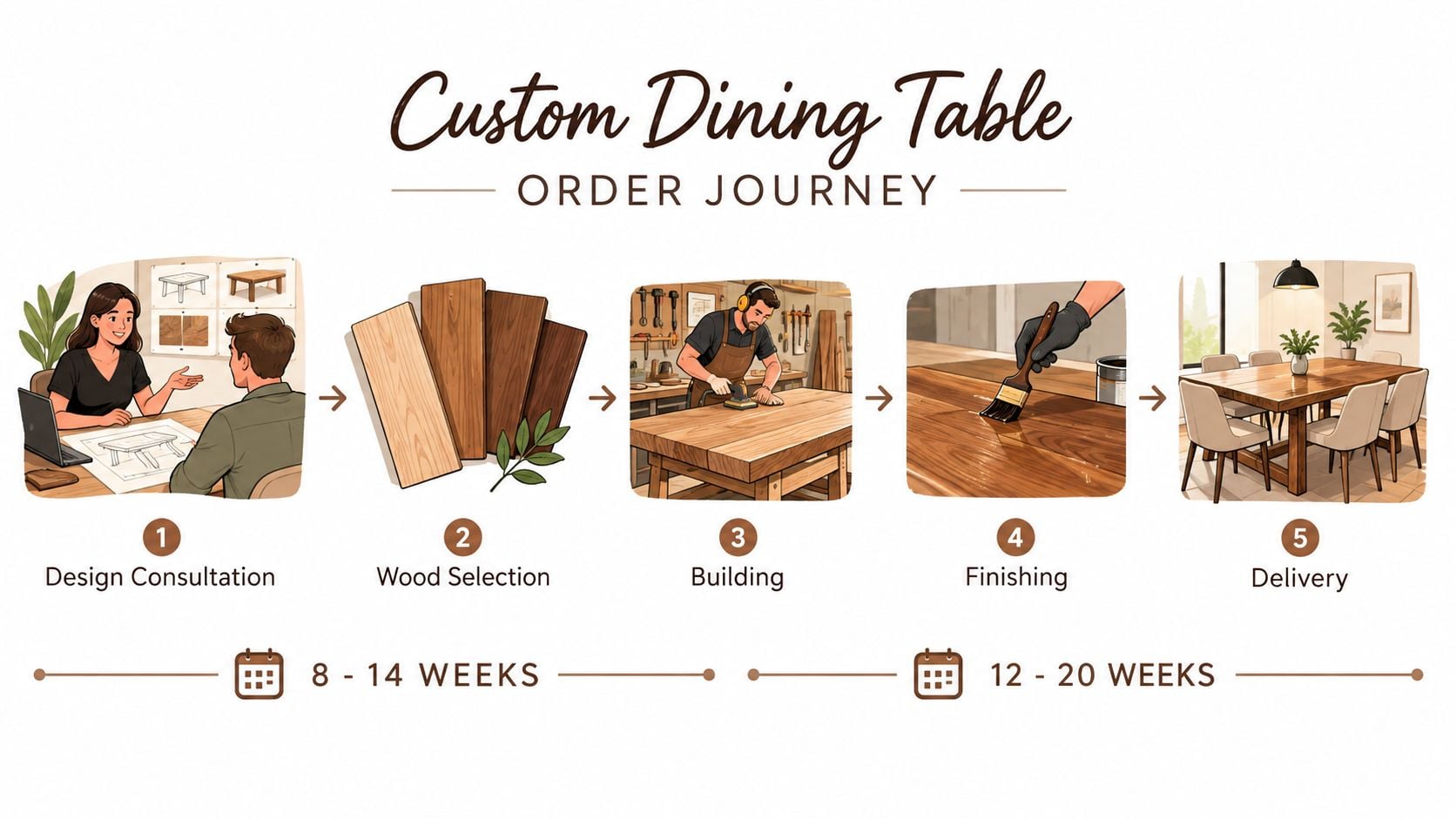
A custom order becomes far less intimidating when the household knows what happens after the design conversation. The process usually starts with room measurements, photographs, and a discussion of daily seating, then moves through size, shape, wood, finish, edge, base, and chair coordination. Groen's Fine Furniture can present Canadel dining configurations and Amish solid-wood options as distinct paths, so the buyer can compare a highly configurable program with handcrafted specifications.
Canadel orders commonly carry an 8 to 14 week lead time, while Amish-built pieces commonly fall within a 12 to 20 week window. Those timelines are order-planning benchmarks, not guarantees, and rush options rarely exist for solid-wood construction. Any household furnishing a new home or planning around a major event should order before the table becomes urgent.
What happens after the order is placed
A deposit is commonly 50% at order, with the balance due on delivery. Before production, the buyer should review wood samples and finish chips against the flooring, cabinetry, wall color, and actual room lighting. If a stain looks wrong beside the floor, that is the time to change direction. Once production begins, changing the wood species can mean restarting the build, affecting both timing and cost.
Delivery should be discussed before signing. A White-Glove Delivery service may include bringing the table to the room of choice, attaching the legs on-site, removing packaging, and checking placement. The exact service depends on the order and delivery arrangement, so the showroom should spell out what is included.
Custom solid-wood tables commonly fall between $2,800 and $8,500 for the table alone, with the range influenced by dimensions, construction, wood, edge, base, and finish, as described in the provided custom-order pricing guidance. Extendable mechanisms, premium woods such as walnut or cherry, and upgraded edge profiles can add cost. Special Financing may be available through furniture showrooms, subject to credit approval, giving households additional buying power without promising a specific rate or payment.
The final order checklist
Before approving the specification, the buyer should confirm:
- Room measurements: Clearance, doors, traffic paths, radiators, cabinets, and light fixtures have been verified.
- Shape: The table shape supports actual seating needs and daily circulation.
- Wood and stain: The species and finish have been compared with flooring, cabinetry, and home lighting samples.
- Edge profile: The edge feels comfortable for the household and suits the room's level of formality.
- Leg or base style: The base matches the table scale, protects knee room, and supports the intended number of seats.
- Chairs: Seat height, apron clearance, arm width, upholstery, and pushback space have been considered.
- Timeline: Production and delivery align with moving dates, holidays, renovations, or other home events.
- Budget: The plan includes the table, chairs, delivery, and any selected extension or upgraded details.
The showroom conversation should begin with measurements, room photographs, and swatches from existing flooring or cabinetry. That information keeps the design grounded in the actual home instead of a staged display. Groen's multigenerational team serves Dyer, Crown Point, St. John, Schererville, Munster, and surrounding Northwest Indiana communities with custom furniture guidance, Interior Design support, White-Glove Delivery, Special Financing subject to credit approval, and trusted brands including Canadel, Flexsteel, Bassett, Serta, Beautyrest, and Amish Furniture.
Visit Groen's Fine Furniture in Dyer or Crown Point with dining-room measurements, photos, and finish samples to explore a custom Canadel or Amish solid-wood table. The team can help coordinate the table and chairs, explain Special Financing options subject to credit approval, and invite each household to test-drive the comfort before ordering.