What Is an Innerspring Mattress? a Complete Guide


For homeowners in Dyer and Crown Point who wake up stiff, roll toward a sagging middle, or wonder why a partner's every turn shakes the whole bed, the label on a new mattress can feel more confusing than helpful. Shoppers across Northwest Indiana often start with a simple question, what is an innerspring mattress, then face a wall of coil counts and firmness names. The answer is easier than the marketing suggests, and it starts with what's hidden under the cover.
What an Innerspring Mattress Really Is
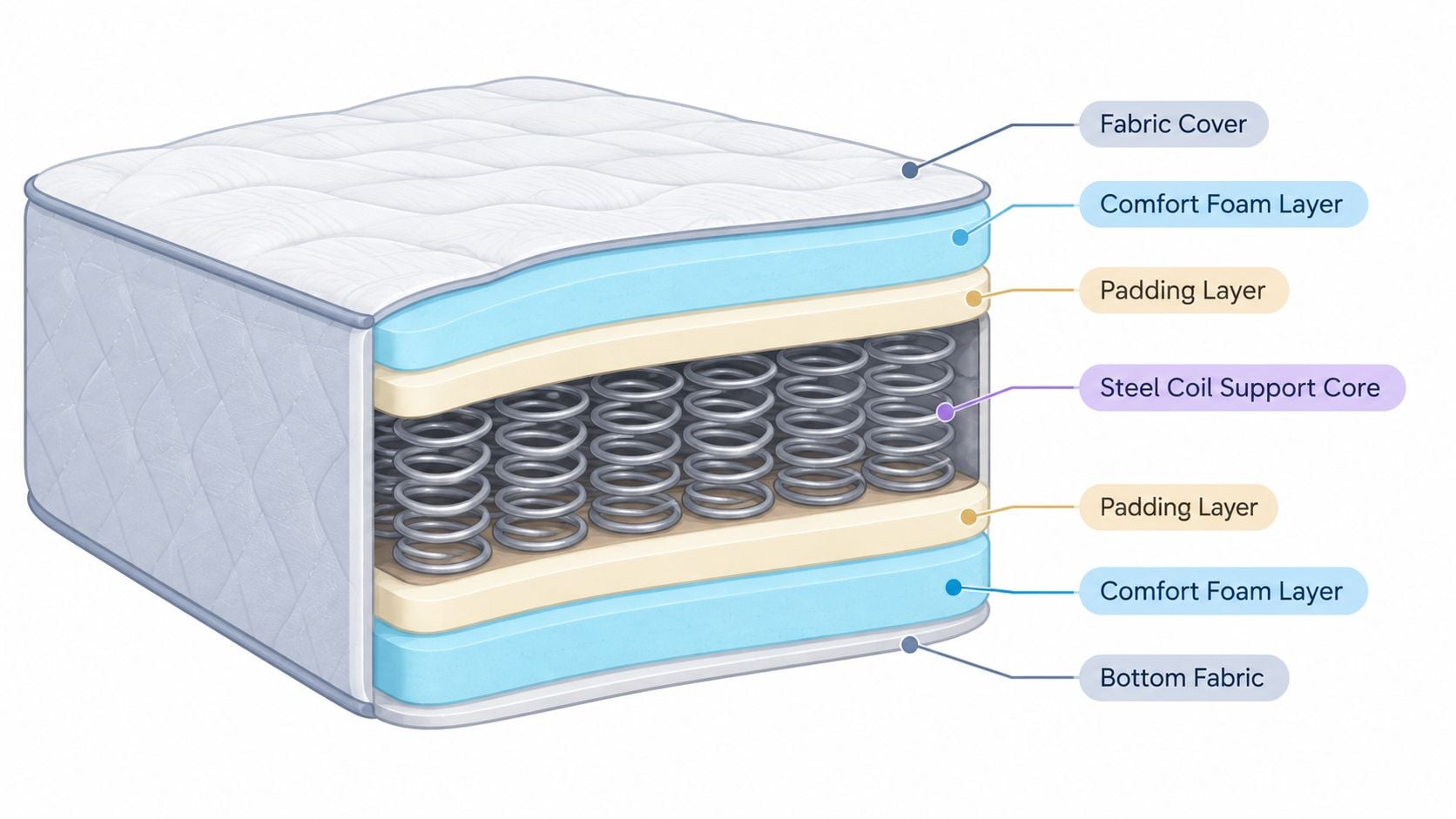
A shopper lies down in a showroom, feels a pleasant bounce, and asks what the coils underneath are doing. That question gets to the heart of it. An innerspring mattress is a bed built around an internal steel-coil support unit, covered by upholstery and a quilted surface rather than relying primarily on a solid foam core, as explained in Koala's overview of coil mattress construction. The springs do the heavy lifting.
Picture the mattress from the bottom up. The coil core sits at the base and carries the sleeper's weight, spreading that load across the bed. Above it sits the comfort system, which may include cotton, wool, fiber, or foam. That upper padding is what a sleeper feels first, and it shapes pressure relief at the shoulders and hips while the coils below provide resilience.
A design with a long track record
This isn't a new invention searching for a purpose. German inventor Heinrich Westphal is widely credited with patenting an innerspring mattress in 1871, using steel coils originally associated with carriage or seat construction. In 1899, James Marshall developed individually wrapped coils, now generally called Marshall coils or pocketed coils. The technology started out expensive, yet by the 1930s innerspring designs represented the vast majority of mattresses sold.
That history explains why the word feels familiar, but it also hides an important catch. Innerspring describes the support system, not a single firmness or feel. Two models can share the label and behave very differently because their coil arrangements, upholstery, and surface padding differ.
Practical rule: Treat "innerspring" as a description of what's inside, not as a promise about comfort. The layers above the coils decide much of what a sleeper notices first.
A thin comfort layer over firm coils feels taut and responsive. A thicker, softer layer over the same type of core can feel plush and cushioned. That's why comparing labels alone doesn't work. Shoppers get further by asking what kind of coils are inside and what sits on top of them.
The Four Main Coil Types Explained
Coil architecture is where one innerspring stops resembling another. Four major constructions show up again and again, Bonnell, offset, continuous-wire, and pocketed coils, according to Sleep Foundation's guide to mattress coil types. Each handles weight and movement in its own way, and the differences are easy to picture with the right analogy.
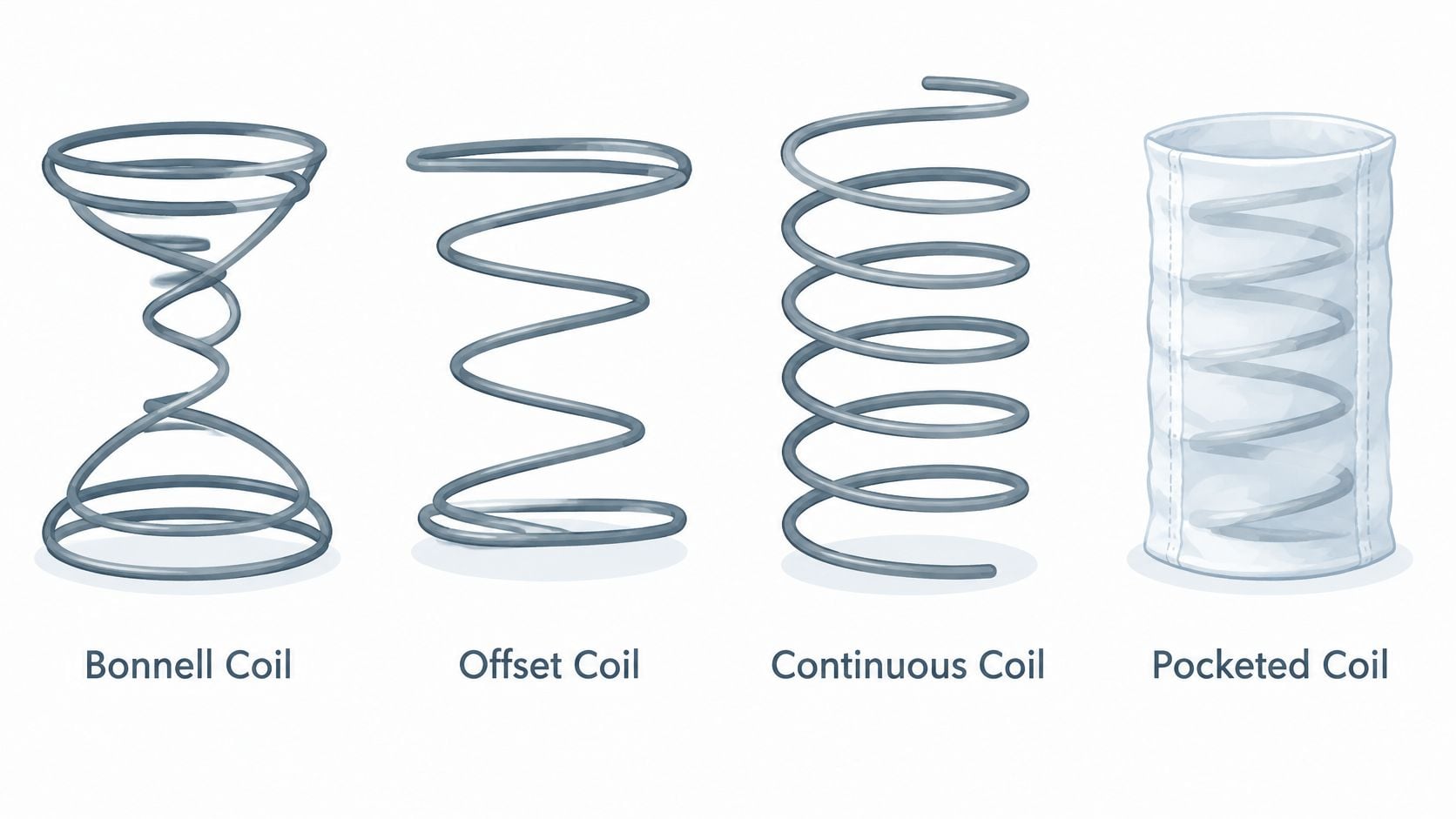
Bonnell coils are hourglass-shaped and interconnected, laced together into one network. They're a bit like a chain-link fence. Push on one spot and the surrounding structure moves too. That shared response creates a buoyant, traditional bounce, but movement on one part of the mattress can travel through the coil network to the other side.
Offset coils keep the connected idea but soften it. They use hinged, squared-off coil heads, and that hinge lets the surface contour a little more readily under curves like shoulders and hips. Some connected movement remains, so they aren't as isolating as pocketed designs, but the feel is generally less rigid than a classic Bonnell unit.
One wire versus individual sleeves
Continuous-wire systems form many coils from a single strand of wire. Because everything is one piece, the unit responds as a connected whole, distributing force broadly across neighboring springs. Shoppers who like a firm, even, responsive surface often recognize this feel right away.
Pocketed coils take the opposite approach. Each spring sits in its own fabric sleeve and compresses on its own, more like individual springs lined up in pockets than a single net. Because they respond more independently, they generally reduce motion transfer and allow more localized support where the body presses deepest.
- Connected systems: Bonnell, offset, and continuous designs share movement across the bed, which feels lively but can disturb a partner.
- Independent systems: Pocketed coils isolate movement and contour more precisely to one sleeper's side.
- Edge behavior: Coil design and perimeter construction together shape how stable the border feels when someone sits or sleeps near it.
None of these is automatically right for everyone. The useful question isn't which coil type wins in the abstract. It's how a specific sleeper moves, shares the bed, and prefers the surface to respond.
Coil Count and Gauge What Actually Matters
Few numbers get more showroom attention than coil count, and few deserve less. A queen-size innerspring commonly contains roughly 400 to 1,200 individual coils, yet testing summarized in Sleep Foundation's innerspring mattress research found that total coil count didn't play a significant role in either perceived support or overall performance. A bigger number on a tag doesn't guarantee a better night.
That surprises people, because more sounds like better. The catch is that coils differ in size, shape, and wire thickness, so counts aren't comparable across designs. A mattress can pack in many small coils and still feel less supportive than one with fewer, sturdier springs and better cushioning above them.
Gauge runs backward
Coil gauge describes wire thickness, and the scale works counterintuitively. A lower gauge means thicker wire. Most traditional innerspring coils fall between approximately 12.5 gauge and 17 gauge. Lower-gauge steel generally produces a sturdier, more supportive feel, while higher-gauge wire tends to feel more flexible and springy.
Gauge still doesn't tell the whole story on its own. The number of working turns in a coil, its height, steel content, tempering, and the amount and type of cushioning above the springs can all influence resilience, pressure relief, firmness, and durability. Two coils with the same gauge can behave differently if their shapes or turn counts differ.
Coil Specs at a Glance
| Specification | What It Means | Impact on Feel |
|---|---|---|
| Coil count | Total number of springs in the unit | Weak predictor of support by itself |
| Gauge | Wire thickness, lower number means thicker | Thicker wire feels firmer and more load resistant |
| Coil type | Connected or pocketed construction | Shapes motion transfer and contouring |
| Turns and height | Shape and travel of each spring | Influences resilience and response |
| Comfort layers | Foam, fiber, or padding above coils | Drives initial pressure relief |
A larger advertised coil count doesn't automatically mean better support. Comparing coil design, wire gauge, comfort layers, and overall construction tells a shopper far more than any single number.
The most meaningful test, in the end, is whether the complete combination of spring system and comfort layers supports the body while maintaining comfortable pressure relief. Specs narrow the field. Lying down settles it.
Innerspring vs Memory Foam vs Latex vs Hybrid
Every mattress type makes trade-offs, and innerspring is no exception. Its construction creates a balance between responsiveness, load distribution, motion transfer, and long-term shape retention, as outlined in Sleep Foundation's durability research methodology. Interconnected coils spread force across neighboring springs for a buoyant feel, while pocketed coils allow more localized compression. Conventional innerspring mattresses commonly retain their shape for roughly 5.5 to 6.5 years, with sagging influenced by construction and coil design.
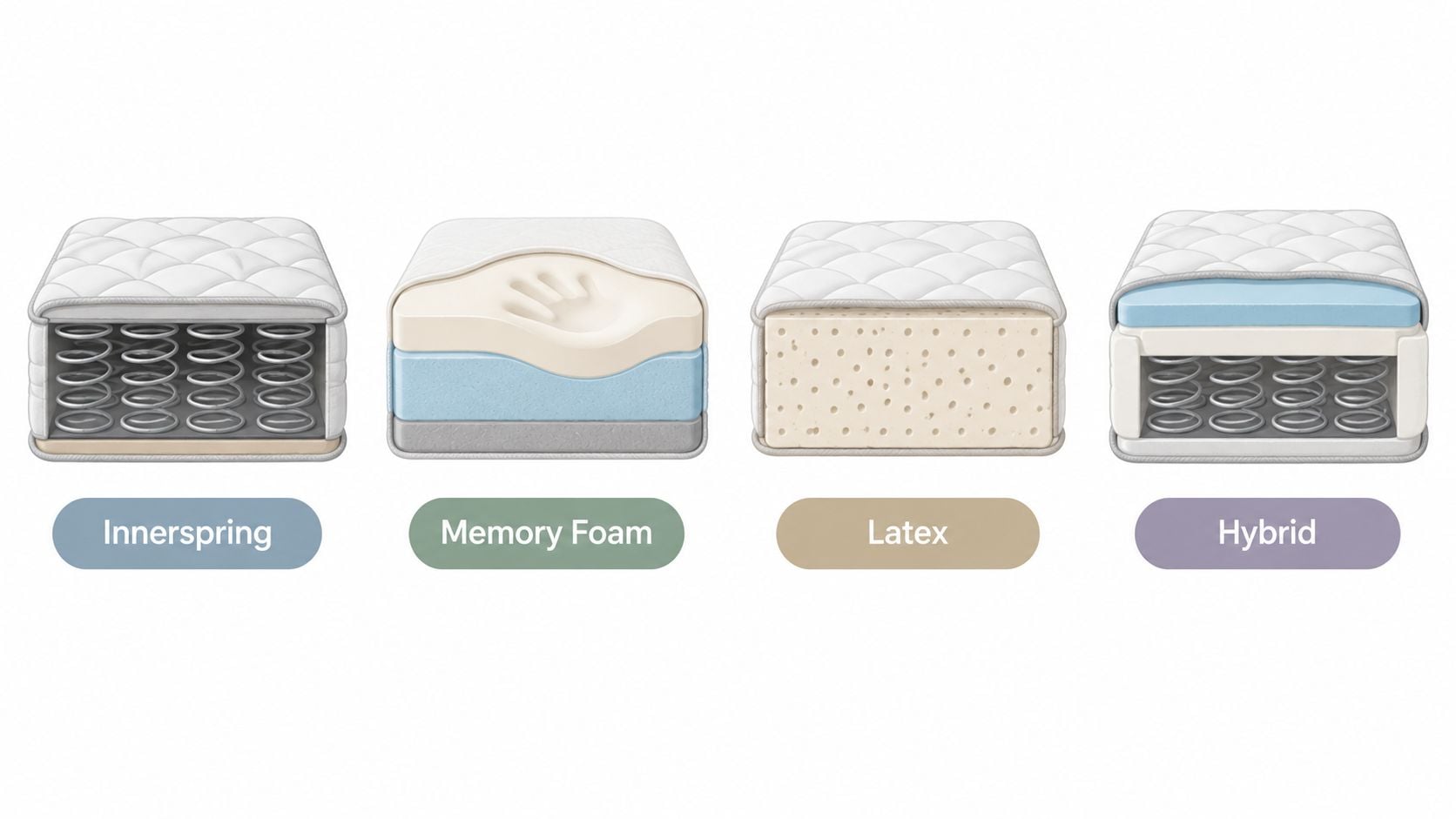
Memory foam takes the opposite route. Instead of springs pushing back, foam layers soften under heat and pressure and contour closely to the body, which many side sleepers love for shoulder and hip relief. The trade-off is a slower response when changing positions and a surface that can feel warm. Readers curious about cooling variations can consult this guide to gel foam mattresses for UK shoppers for background on how gel infusions aim to manage heat. A side-by-side look at innerspring and memory foam construction differences helps clarify which feel suits a given sleeper.
Where latex and hybrids fit
Latex offers a resilient, responsive surface without steel coils. It contours less than memory foam and springs back quickly, so changing positions feels easy. For sleepers who want bounce without a traditional connected coil unit, latex often lands in a comfortable middle ground.
Hybrid mattresses combine a coil core with more substantial foam or latex comfort layers on top. The goal is balance, coil support and airflow below, plus meaningful pressure relief above. Because the upper layers are thicker than on a basic innerspring, hybrids can soften the pushback some sleepers feel from springs while keeping the bed responsive.
- Choose innerspring for: A familiar, buoyant feel and easy movement across the surface.
- Choose memory foam for: Deep contouring and strong motion isolation for couples.
- Choose latex for: Responsive support with a naturally resilient surface.
- Choose hybrid for: Coil support paired with thicker cushioning for pressure points.
No category wins for every household. Body weight, sleep position, and whether a partner shares the bed matter more than category loyalty. The comparison helps a shopper walk into a showroom with a shortlist instead of a guess.
Who Should Choose an Innerspring Mattress
An honest answer starts with a slightly contrarian point. Research summarized in Mattress Vetted's innerspring mattress analysis found that both new innerspring and new latex mattresses significantly improved sleep, suggesting part of the benefit came from replacing an old mattress rather than from the surface type itself. Weakened springs can eventually reduce comfort and sleep quality, so the age and condition of the current bed deserve real weight in the decision.
That doesn't make construction irrelevant. It means shoppers should match construction to their own habits. Combination sleepers who shift between back and side positions often appreciate how quickly coils respond, since the surface doesn't hold them in one molded spot. Rolling over takes less effort, and the bed feels ready for the next position.
Couples have a different priority. If one partner's movements wake the other, pocketed coils that compress independently can reduce that disturbance. Reading about matching a mattress to different body types is a useful step before testing models together in person.
Weight, temperature, and daily habits
Body weight changes how coils and comfort layers work together. Heavier sleepers typically need the support of thicker, lower-gauge wire so the surface doesn't bottom out, while lighter sleepers may not compress a very firm unit enough to get pressure relief. Neither preference is a flaw. It's physics meeting anatomy.
Temperature deserves the same nuance. Open space around coils can promote airflow, but actual heat retention also depends on foam density, upholstery, coverings, bedding, room temperature, and the sleeper. Someone who sleeps hot shouldn't rely on the word innerspring alone as a cooling guarantee.
People who sit on the edge of the bed to dress, read, or help a child settle should also pay attention to perimeter stability. Innerspring can be a strong fit for many households, provided the specific coil type, gauge, and comfort layers line up with the sleeper using it every night.
Key Specs to Look For When Shopping
A confident shopper doesn't need an engineering degree. A short list of good questions does most of the work. Performance depends on measurable variables including wire gauge, coil geometry, number of turns, connectivity, and the cushioning system above the springs, as described in peer-reviewed research on mattress spring performance. Mattress coil wire commonly ranges from approximately 12 to 15 gauge, with 13 reported as typical for many mattresses, though gauge should be interpreted alongside coil height, diameter, turn count, and body weight.
The ASTM F1566 standard offers a more rigorous lens than showroom feel alone. It identifies firmness, firmness retention, durability, impact response, and height change as relevant performance measures for mattresses and their spring components. A salesperson who can discuss tested performance, not just advertised counts, is giving useful information.
Questions worth asking out loud
- Are the coils connected or pocketed: This predicts motion transfer and contouring better than almost anything else.
- What's the wire gauge: Lower numbers mean thicker, firmer, more load-resistant wire.
- What sits above the coils: Foam, fiber, and padding thickness can substantially change the perceived firmness of the same coil unit.
- How is the edge built: Thicker coils and a sturdy perimeter can improve edge stability, a topic covered in detail in this overview of how mattress edge support works.
- Is it one-sided: Flipping a one-sided design can damage its intended comfort layering, so rotation should follow manufacturer guidance.
Answers to those five questions reveal more than a spec sheet full of counts. They also make comparisons fair, because two mattresses can finally be judged on the same terms. A shopper who asks them isn't being difficult. That shopper is being careful with a purchase that affects every morning.
Testing Mattresses at a Local Showroom
Specs can be compared on paper, but comfort can't. The word innerspring no longer describes one uniform experience, a point made clearly in AARP's guide to innerspring mattress selection, which notes that connected coils transmit more movement while pocketed coils reduce it because each spring responds independently. That range is exactly why testing in person matters for couples and combination sleepers.
A useful showroom visit follows a simple routine. The shopper lies down in the position used at home, on the side or back, and stays long enough for the body to settle rather than judging the first few seconds. Spinal neutrality is the goal. Shoulders and hips should sink enough for relief without the midsection sagging out of line.
A practical in-store routine
- Test the edge: Sitting near the border shows whether the perimeter holds up or collapses.
- Test motion with a partner: One person rolls or shifts while the other notes how much movement crosses the bed.
- Test position changes: Rolling from back to side reveals whether the surface helps or resists movement.
- Ask the construction questions: Coil type, gauge, comfort layers, and edge reinforcement should all get straight answers.
Local guidance adds something a product page can't. At Groen's Fine Furniture, mattress experts help customers compare innerspring, memory foam, and hybrid options from brands such as Serta and Beautyrest, and the store offers Special Financing, subject to credit approval, for shoppers who prefer to spread out the purchase. Families from St. John, Schererville, and Munster can review these practical mattress shopping tips before visiting.
Showroom principle: A mattress that looks right on a spec sheet still has to feel right under an actual body, in an actual sleep position.
That test drive protects sleep wellness for years. Fifteen unhurried minutes on a showroom floor beats weeks of guessing from online descriptions, because the body gives honest feedback that marketing language can't replicate.
Frequently Asked Questions About Innerspring Mattresses
Do innerspring mattresses sleep cooler than foam
They can, since open space around coils promotes airflow, but the full picture includes foam density, upholstery, coverings, bedding, and room temperature. A coil bed with thick, dense foam on top won't necessarily feel cool. Sleepers who run warm should evaluate the whole build, not the support core alone.
How long does an innerspring mattress last
Longevity depends on construction, coil design, usage, and care rather than on the label alone. Visible body impressions, new aches, and a surface that no longer feels supportive are practical warning signs. Rotating the mattress when the manufacturer permits it helps, while flipping a one-sided model can damage its layering.
Is an innerspring good for back support
Support comes from how well the complete mattress keeps the spine neutral in the sleeper's usual position. Coil gauge, coil type, and comfort layers all contribute, so a firm-sounding label doesn't guarantee good alignment. Testing side and back positions in person gives the clearest answer for an individual body.
Does a hybrid count as an innerspring
A hybrid uses a coil support core, so it shares innerspring DNA, but its thicker foam or latex comfort layers change the feel substantially. Shoppers should also confirm the base underneath, since pairing questions often come up alongside guidance on choosing between a mattress foundation and a box spring. The right support underneath helps any mattress perform as designed.
Homeowners who want to feel the difference between connected and pocketed coils for themselves are invited to test drive innerspring, hybrid, and memory foam models at Groen's Fine Furniture, with showrooms in Dyer and Crown Point and a family team that has served Northwest Indiana since 1983. The visit includes honest guidance on matching coil construction to sleep position and body type, plus the option to ask about special financing plans, subject to credit approval, that make quality rest fit the household budget. Visit Groen's Fine Furniture in Dyer or Crown Point today to explore the options in person, and let the Groen family help create a home that sleeps as good as it looks.