Blog
Why a Leather Reclining Sofa and Loveseat Earns Its Place

A lot of Northwest Indiana homeowners walk into a furniture showroom with the same look on their face. They already know they want comfort, but they haven't decided whether a leather reclining sofa and loveseat will fit the room, fit the budget, or still feel like a smart purchase a few years from now. The hesitation usually isn't about color. It's about what's hiding under the leather, behind the back, and inside the mechanism.
That hesitation is healthy. A reclining set changes how a family room works. It can turn movie nights, Sunday football, and ordinary weeknights into the part of the day everybody looks forward to. It can also eat up too much space, wear poorly at the fold lines, or disappoint fast if the leather coverage isn't what the tag implied.
For homeowners in Dyer, Crown Point, St. John, Schererville, and Munster, the right answer usually comes down to four questions. Is the set really leather where it counts. Is the mechanism right for the way the household relaxes. Will it clear the wall and traffic path. And does the build justify the price. Those are the questions worth asking before anybody falls in love with the look.
A Living Room Built Around Real Comfort
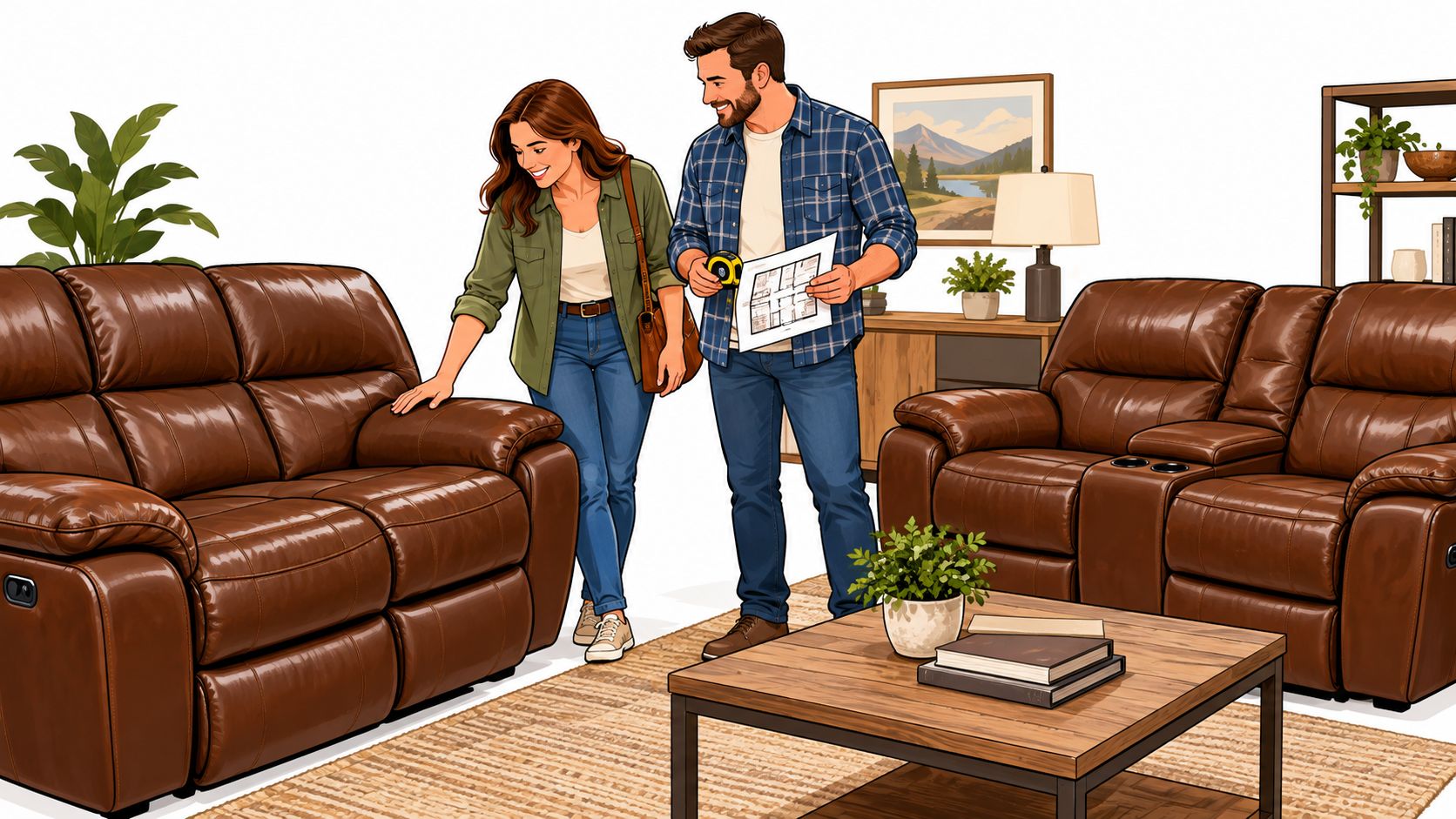
A Northwest Indiana couple walks in with phone photos of the family room, rough measurements, and the same concern I hear every week. They want real comfort, but they do not want to spend good money on a leather reclining sofa and loveseat that looks impressive for ten minutes and creates headaches for the next ten years.
That is the right concern.
A reclining set changes the way a room works. People sit longer, stretch out more often, and start using the room differently on ordinary nights, not just holidays or game days. The wrong set crowds the walkway, hits the wall, and costs more than its build quality deserves. The right one earns its place every single day.
In the showroom, the hesitation usually comes down to four questions, and they are the right ones to ask.
- How much of it is leather? Some sets give you leather on the main contact areas and a match material on the sides and back. That is not automatically a bad value, but it needs to be priced like it.
- What kind of recline mechanism are you paying for? Manual and power feel very different in daily use, especially for anyone who reclines often.
- How much space does it need to function well? Wall clearance matters, but traffic flow matters just as much.
- Does the sofa and loveseat set justify the price over other layouts? Sometimes the pair is exactly right. Sometimes two recliners and a stationary sofa make more sense.
I like buyers who ask those questions before they fall in love with the look of a set. They usually make better choices.
What buyers notice first
The first thing people react to is the seat. If the pitch is wrong, if the headrest pushes the chin forward, or if the footrest hits at an awkward angle, the sale usually dies right there. Good reclining furniture should feel natural within a few seconds. You should not have to talk yourself into it.
Then the practical questions start. A loveseat with a center console sounds great until a couple realizes they want to sit close together. A generously padded arm looks inviting until it makes the whole piece too bulky for the room. Those details matter more than showroom styling.
Why this set can change the whole room
A leather reclining sofa and loveseat works best when comfort is the main job of the room. Family rooms, finished basements, and everyday gathering spaces are where this category shines. The loveseat becomes the quiet seat for reading, streaming, or a quick nap. The sofa handles movie night, visiting family, and the spot everybody drifts to by the end of the evening.
That is why I rarely frame these sets as a style purchase first. They are a use purchase. If a room gets lived in hard, comfort needs to lead the decision, and the design needs to support it instead of fighting it.
Buy the set because it answers real daily needs. Skip it if you are only buying the look.
Understanding Leather Grades and What the Labels Actually Mean
Leather labels confuse a lot of good shoppers because the tag sounds better than the actual upholstery. On a reclining sofa and loveseat, I care less about the word leather and more about three things: what part of the hide it came from, how heavily it was finished, and exactly where it's used on the piece.
That last part matters more than buyers expect. A set can feel great on the seat and arms, then use a different material on the outside backs and sides. There is nothing automatically wrong with that. You just need to know what you are paying for.
What the different leather grades actually are
Full-grain leather keeps the natural top surface of the hide. You'll see more grain variation, more markings, and more personality over time. It appeals to buyers who want a broken-in, natural look and are fine with leather showing real life.
Top-grain leather also comes from the upper hide, but the surface is usually refined and protected. This is the grade I recommend most often for active Northwest Indiana households. It still feels like real leather, but it usually gives you an easier finish to live with day to day.
Corrected-grain leather has been sanded or altered more heavily, then finished for a more even appearance. It can look clean and consistent on the floor. It usually gives up some of the natural character buyers expect from better leather.
Split leather comes from the lower portion of the hide. It has its place, but I do not like seeing it in high-contact, high-flex seating areas on recliners.
| Leather Grades Compared | Hide Layer | Durability & Feel |
|---|---|---|
| Full-grain | Top layer with natural surface retained | Natural character, strong, shows patina and use more honestly |
| Top-grain | Upper hide with a refined or protected finish | Durable, smoother, easier for many families to maintain |
| Corrected-grain | Surface-corrected upper portion | More uniform look, less natural texture and depth |
| Split leather | Lower hide layer | Less desirable for heavy-use reclining contact points |
Why the label alone is not enough
A leather sample can feel soft in the showroom and still disappoint on a recliner. Reclining seats flex in the same spots over and over, especially at the footrest break, the seat deck, and the back cushion fold. That repeated motion is where weaker leather, weaker finish systems, or thin coverage show themselves first.
Good upholstery leather is judged by practical performance basics such as flex resistance, tear strength, finish adhesion, colorfastness, and resistance to water spotting. You do not need a lab report in your hand. You do need straight answers about whether the leather is built for motion furniture or just made to sound impressive on a tag.
I tell buyers this all the time. A pretty leather name means very little if the seating area creases hard, dries out fast, or wears through at the exact points that move every night.
A recliner tests upholstery harder than a stationary sofa does. If the leather and finish are not up to the job, the wear shows at the motion points long before the frame gives you trouble.
The questions worth asking at the tag
Skip vague questions. Ask the ones that expose value fast.
- Where is the genuine leather used: Seats, arms, footrests, inside backs, outside backs, and outside arms?
- Is it all leather or leather match: If it is matched, which panels are matched?
- Is the finish more natural or more protected: A protected finish usually makes better sense for busy homes, pets, and everyday use.
- Will this leather patina or stay more uniform: Neither is better. They are different looks with different expectations.
- What does the warranty cover: Leather finish wear, seam failure, cushioning, or only the frame and mechanism?
For homeowners comparing materials beyond leather alone, this upholstery materials guide gives a clear breakdown of how different coverings behave in daily use.
Here's my blunt advice. If a leather reclining sofa and loveseat carries a serious price, the retailer should be able to tell you exactly what leather is on the body, what is on the contact areas, and why that set earns the money. If those answers are fuzzy, keep shopping.
Manual Versus Power Reclining Mechanisms
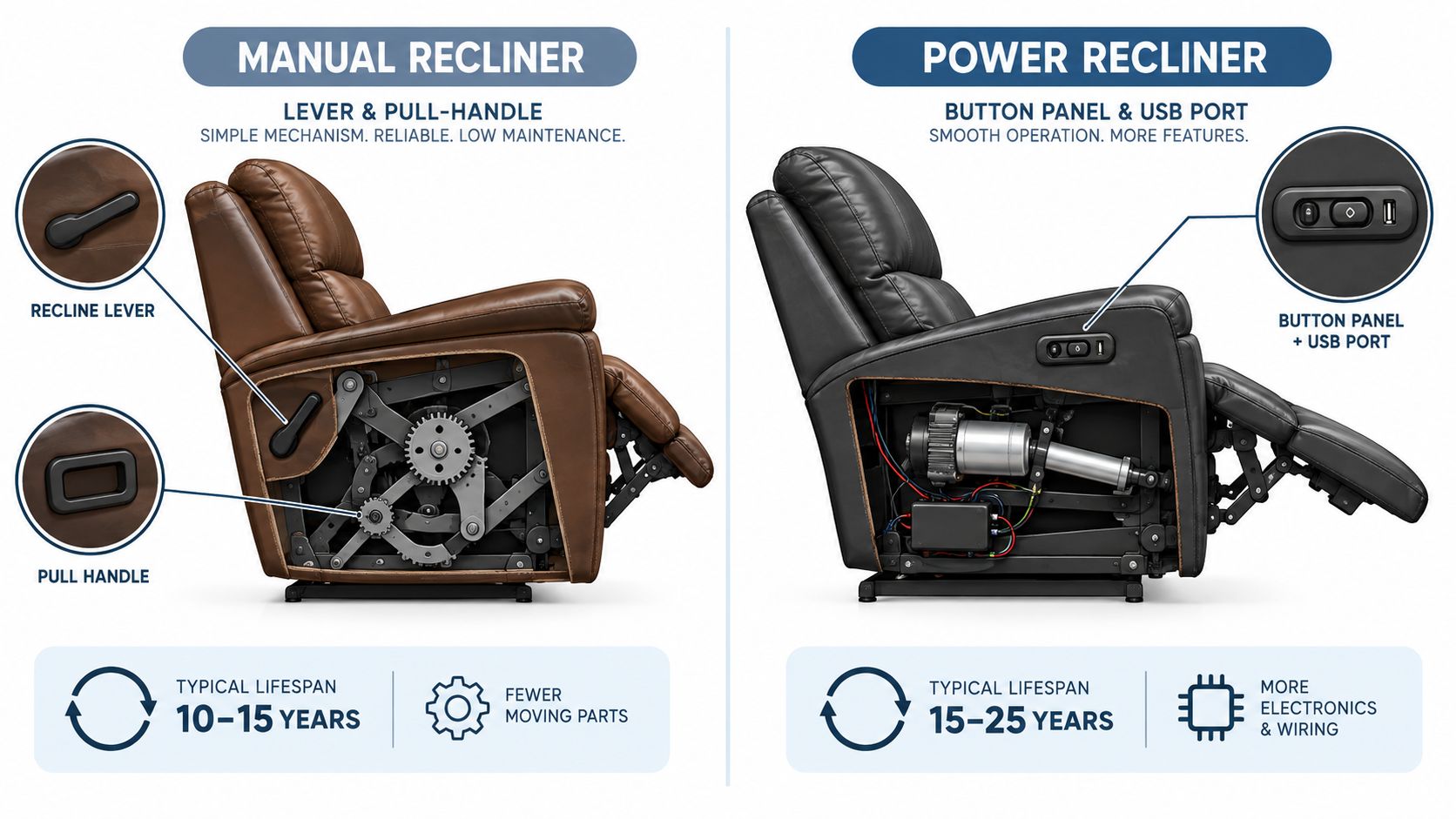
You feel this decision in the first week at home. A manual recliner that seemed fine on the showroom floor can turn into a seat nobody bothers to open on a tired Tuesday night. A good power recliner gets used because it is easy, consistent, and comfortable every time.
Manual recline works best for simple, occasional use
Manual reclining mechanisms appeal to buyers who want fewer powered parts and a lower opening price. They are usually lighter, easier to place, and straightforward to operate if the user has no trouble pushing back the seat and closing the footrest.
That said, I do not recommend manual just because it costs less. On a sofa or loveseat that gets used every night, the extra effort matters. If one person in the house has knee, hip, shoulder, or back issues, manual can become annoying fast. The seat should work for the people using it, not ask them to fight it.
Power recline earns its keep in daily-use rooms
Power recline is the better choice for a lot of Northwest Indiana homes because people use these rooms hard. Family rooms become TV rooms, nap rooms, and phone-charging stations. A push-button mechanism makes it easier to fine-tune the angle, raise the footrest without a shove, and stop where your body feels right instead of where the mechanism happens to catch.
The feature that gets overlooked most often is independent adjustment. A power headrest or lumbar function is not fluff if you read, stream, or sit upright without wanting your legs fully up. That is where price starts making sense.
The showroom questions buyers hesitate to ask, but should
Mechanism choice is not only about manual versus power. Ask the questions that expose whether the set is worth the money:
- How many motors are in the seat: Basic power, power headrest, or power lumbar all change how precisely the seat fits you.
- Where are the controls located: Side buttons are common, but some buyers strongly prefer cleaner inside-arm controls or a home-all button.
- How close can it sit to the wall: Wall clearance affects placement more than buyers expect.
- How hard is it to close in a manual version: Try it yourself, then picture doing it at the end of a long day.
- What happens if the power goes out: Battery backup availability matters for some households.
- Does the loveseat give both people the same motion options: Some sets look symmetrical but do not function that way.
For a closer look at how these setups compare in everyday use, read this power recliner versus manual recliner guide.
My recommendation
If the leather reclining sofa and loveseat will be used several nights a week, buy power. If the room is used lightly, the budget is tighter, and everyone using it is comfortable with the motion, manual still has a place.
I would also be picky about paying up for power unless the comfort gain is obvious. If a set adds motors but still gives you awkward control placement, limited stopping positions, or clumsy movement, keep looking.
The right mechanism should disappear once you sit down. If you notice the effort every time you recline, it is the wrong one.
Sizing and Configuration for the Way You Actually Live
You feel great in the showroom. Then the sofa gets to your house, the footrest blocks the main walkway, the loveseat crowds the end table, and nobody checked the basement turn. That is how good-looking reclining furniture becomes a daily annoyance.
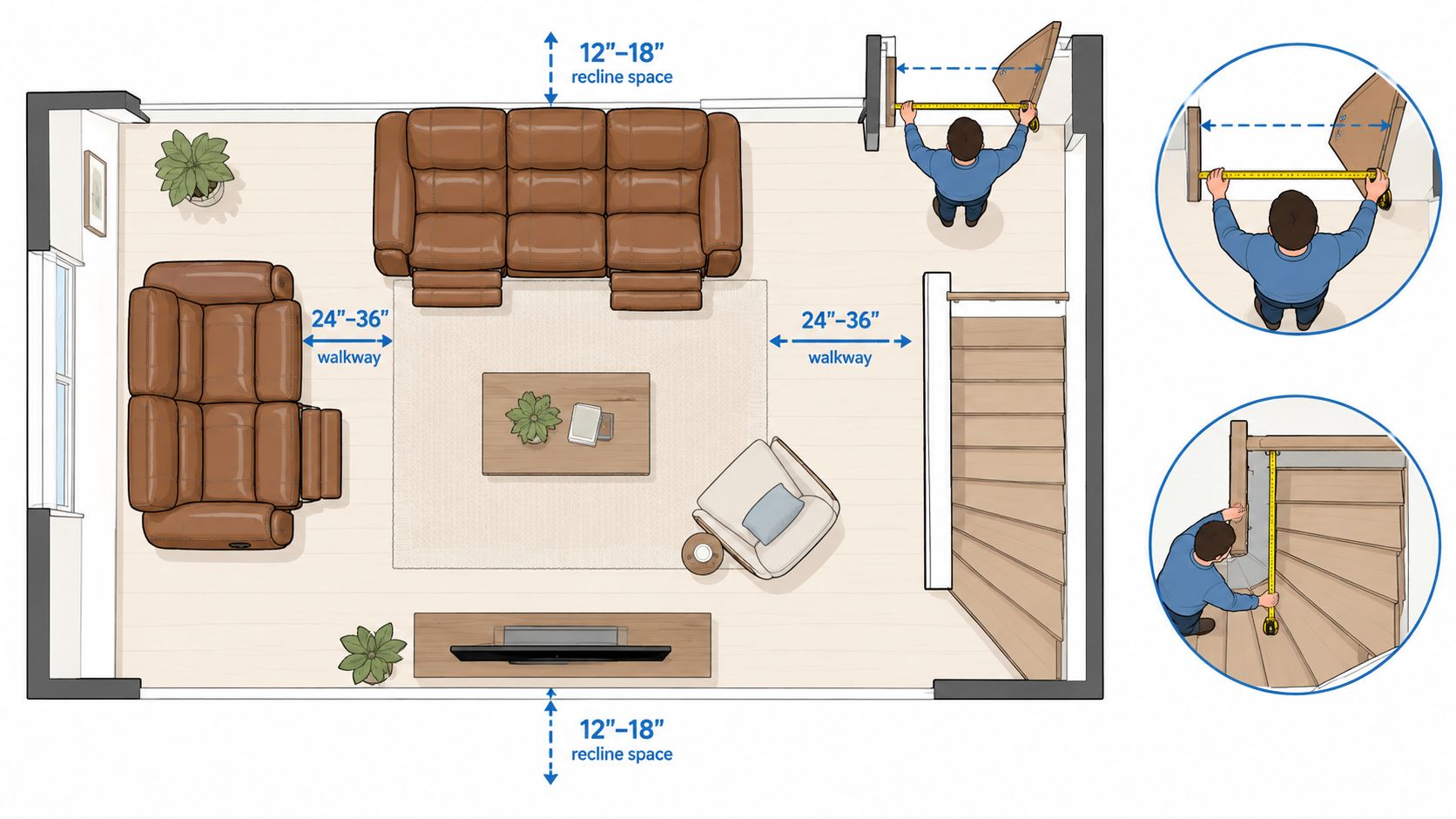
A leather reclining sofa and loveseat need more than wall width. You need usable depth, clear traffic lanes, and a delivery path that does not turn into a headache on install day. I see this all the time in Northwest Indiana homes, especially older ranches with short wall sections, narrow entries, and tight corners near the family room.
The measurements that actually save you trouble
Start with the room, not the tag.
Measure the wall where the piece will sit. Measure the full room depth with the footrest open, not just the upright footprint. Measure every doorway, hallway, stair turn, and ceiling pinch point between your front door and the final spot. Then stand in the room and mark the walking path people use every day. If the reclined seat cuts through that path, the size is wrong even if the width technically fits.
If you want a simple reference before you buy, use this sofa size guide for measuring room layout and delivery access.
Choose the setup that matches how the room gets used
A lot of buyers ask the wrong question here. They ask which configuration looks better. The better question is who uses the room, how often, and whether both seats need to function the same way.
A reclining sofa works best when you need one long anchor piece and the room can handle its scale. A double reclining loveseat makes more sense for couples who use the room together most nights and want equal comfort. A console loveseat is worth the space only if you will use the storage, cupholders, and charging access. If you like to sit close, skip the console. It puts a divider right where some households do not want one.
I also like a sofa plus a separate recliner when the room has an awkward shape. That setup often solves two problems at once. You get better traffic flow, and one person still gets a true personal seat.
Wall clearance decides more than buyers expect
This is one of the showroom questions people hesitate to ask, and it should be near the top of the list. How far the piece needs to sit off the wall changes the whole floor plan.
Traditional reclining designs need more space behind them. Wall-hugger and zero-wall styles are smarter in tighter rooms because they move forward as they recline instead of eating up space behind the back. In a shorter room depth, that difference matters more than a few inches of overall width.
Here is my rule. If every inch counts, prioritize wall clearance before you start obsessing over style details. A beautiful set that never reclines comfortably in your room is a bad buy.
Seat depth and seat height deserve the same level of attention. Taller users need enough depth and leg support so they are not hanging off the front edge. Shorter users should be able to sit upright with their feet planted comfortably. If that basic fit is off, the room plan and the price stop mattering.
Durability Frames Mechanisms and Brand Quality
A leather reclining sofa and loveseat can look great on the floor and still disappoint fast at home. The pieces that hold up are the ones built right under the leather: the frame, the seat support, the foam, and the reclining hardware.
This is also where buyers decide whether the price is justified. If a set has partial leather coverage, a weak frame, and a light-duty mechanism, the ticket can look a lot less reasonable.
What actually holds up
Start with the frame. I want to see kiln-dried hardwood or other substantial frame construction, reinforced stress points, and arms that do not flex when someone pushes off to stand. Reclining furniture takes more abuse than a stationary sofa because people sit down hard, shift their weight, and work the footrest over and over.
Seat support matters just as much. A soft top layer can fool shoppers for ten minutes. What matters is whether the seat stays level, supportive, and square after repeated use. Better support systems and better cushion build usually outlast a seat that just feels extra plush on day one.
If you want a clearer picture of what stronger upholstery construction looks like, this guide to solid wood frame sofas is a useful place to start.
What I tell shoppers to test on the floor
You can learn a lot in three minutes if you check the right things.
- Grab the arm and apply pressure. It should feel planted, not hollow or loose.
- Recline it more than once. The motion should stay controlled and aligned, without a jerk at the start or a hard stop at the end.
- Listen while you shift your weight. Creaking, frame twist, and popping sounds are early warnings.
- Look at the tailoring. Straight seams, tight stitching, and clean panel matching usually reflect better factory discipline overall.
- Sit back down after reclining. A good seat should return to the same supportive feel, not slump or tilt.
I also pay close attention to the mechanism itself. Some sets are built with lighter hardware that works fine in a guest room but not in the main TV room where it gets used every night. If the loveseat mechanism feels less stable than the sofa, that tells me plenty about where corners were cut.
The smartest shopper is the one who checks repeated motion, seat support, and frame stability before falling for a soft first sit.
Brand quality shows up in consistency
Brand quality is not about a name on the tag. It shows up in consistency across the whole piece. Are the seams clean on both seats. Does the recline feel equally smooth on each end. Do the cushions sit evenly. Does the center stay supportive, or does it already feel tired on the floor sample.
That consistency is what separates a set that ages well from one that starts showing problems early.
Value comes from the parts buyers do not photograph
A well-built reclining set usually costs more because the expensive parts are hidden. Better seat support, stronger joints, denser cushions, and better-aligned mechanisms cost money. They also save frustration.
I tell Northwest Indiana shoppers to be blunt about this question: does this sofa and loveseat earn its price once you get past the leather color and the comfort pitch? If the answer is yes, you should be able to feel it in the frame, hear it in the quiet motion, and see it in the way the whole set holds its shape.
Caring for Leather Through Every Northwest Indiana Season
January furnace heat, July humidity, wet jackets, dog claws, pizza night in the reclined position. That is the test for a leather reclining sofa and loveseat in a Northwest Indiana home. Good leather handles daily life well, but only if you treat it like finished upholstery instead of a car seat or a kitchen countertop.
The routine that actually keeps leather looking right
I tell shoppers to keep the care plan boring. Boring works.
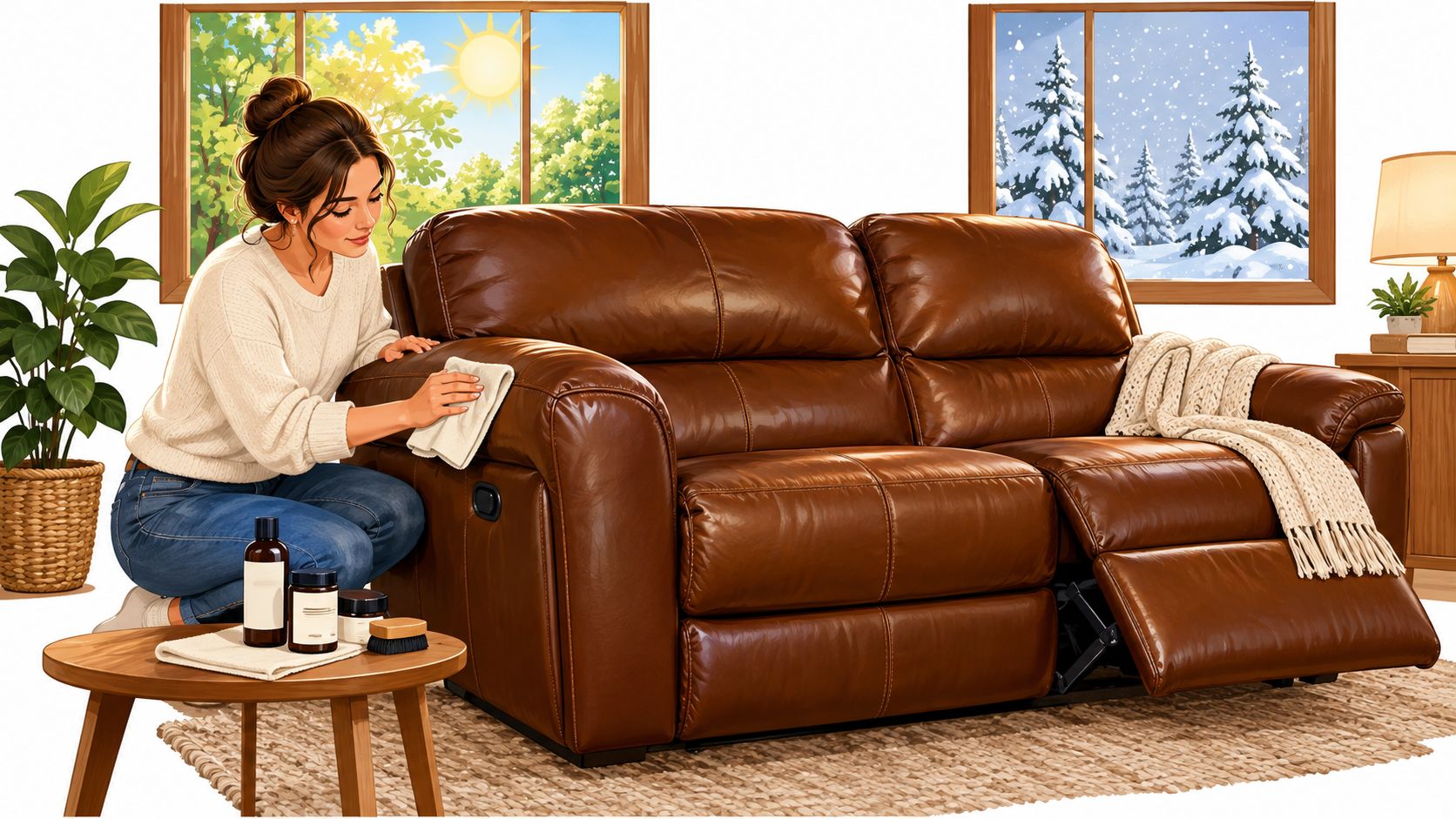
Dust the leather with a soft microfiber cloth. Vacuum the seams, cushion edges, and the areas around the reclining hardware so grit does not sit there and grind into the finish. If someone spills on the seat or arm, blot it fast and stop rubbing. Rubbing spreads the mess and wears the surface faster.
Conditioning matters too, but overdoing it is a mistake. Most finished leather does well with occasional conditioning on a sensible schedule, especially during the dry part of the year. If you want a clear step-by-step routine, use this leather couch cleaning guide.
Northwest Indiana weather changes the job
Winter is harder on leather than many buyers expect. Heated air dries the room out, and the first places to show it are the headrests, arm tops, and seat fronts that get constant contact. Keep reclining seating away from forced-air vents, fireplaces, and wood stoves when you can.
Summer brings the opposite problem. Humid air is not usually what ruins the leather. Body oils, sunscreen, pet hair, and dust sticking to the surface do more of the damage. That is why recliners need extra attention at the fold lines and where the footrest closes. Those tight spots collect grime fast.
Sun is its own problem. If your sofa or loveseat sits near a bright window, expect the color and finish to age unevenly unless you control direct light.
What to avoid
Bad cleaning habits ruin more leather than normal use.
Skip household sprays, silicone shine products, saddle soap, and soaking-wet cloths. Use a small hidden spot first before trying any cleaner or conditioner. If you get a light scuff, review these furniture scratch fix methods before you start experimenting with random home remedies.
Leather does not need constant treatment. It needs consistent, restrained care. Clean the right areas, keep it out of harsh heat and direct sun, and your reclining set will keep its color and feel far longer.
Custom Orders Financing and the Groen's Showroom Experience
You sit in a leather reclining set for five minutes in the showroom, like the comfort, and assume the hard part is over. It is not. The last mistakes usually happen here, after the model is chosen, when buyers rush past the questions that decide whether the set still feels right six months after delivery.
Custom ordering matters because the floor sample is rarely the whole story. The right set for your home may need a different leather match, a different arm shape, a power upgrade, or a layout that fits your traffic path instead of crowding it. I always tell Northwest Indiana homeowners to slow down at this stage and ask the questions they were hesitant to ask at the start. How much real leather is on the piece. Which reclining mechanism they are paying for. How much wall clearance it needs. Whether a sofa and loveseat set earns its price in their room.
A good showroom should make those answers plain. You should be able to handle the leather samples, test the motion side by side, talk through room measurements, and get a straight opinion on whether matching pieces make sense or whether a different combination will serve you better. That is the value of working with a family-owned store that still sells face to face instead of pushing everybody toward the same package.
Groen's Fine Furniture offers that kind of custom ordering across categories and carries a range of trusted upholstery and mattress brands, with showrooms in Dyer and Crown Point.
Financing should help you buy the right set
A better reclining sofa and loveseat costs more for a reason. Better leather coverage, stronger frames, smoother power units, and better seat support all show up on the price tag. Special Financing available, subject to credit approval, gives qualified buyers room to choose the build they want instead of backing into a cheaper set they already distrust.
That matters even more if you are furnishing more than one room. Many homeowners are balancing living room seating with dining, bedroom, or occasional furniture purchases at the same time. Financing can spread out the project and protect the budget for the features that matter most.
- For custom orders: It makes upgraded leather, motion, and comfort features easier to fit into the plan.
- For larger projects: It helps manage timing when more than one room is changing.
- For quality-minded buyers: It keeps the conversation focused on long-term comfort and construction, not just the lowest ticket.
White-glove delivery is part of the purchase
Reclining furniture is heavy, awkward, and easy to damage before you ever use it. Delivery is not a throwaway detail.
White-Glove Delivery matters because placement affects function. The team should bring the pieces into the room, set them where they belong, remove the packaging, and make sure the reclining action has the space it needs. That saves you from the usual problems. Scuffed walls, tight doorways, bad angles, and a power loveseat parked too close to the wall.
For a lot of Northwest Indiana homeowners, the showroom experience comes down to one thing. Clear answers. You do not need another vague sales pitch. You need someone to tell you if the leather is worth the upcharge, if the mechanism matches how you will use it, if the set fits the room, and if the final price makes sense.
Northwest Indiana homeowners looking for a leather reclining sofa and loveseat can compare motion styles, leather options, custom furniture choices, and room-fit details in person at Groen's Fine Furniture. Visit the Dyer or Crown Point showroom to test drive the comfort, ask about White-Glove Delivery, and explore Special Financing available, subject to credit approval. Let a family-owned team with deep local roots help create a home that feels comfortable, lasting, and personal.